One Antibody Shot, Up to 4 Years of SIV Remission in Infant Macaques
A single CCR5/CD3 antibody dose plus early therapy kept SIV away for months, and up to four years in one animal. What the macaque study does and doesn't show.
Somewhere in a primate research colony in California there is a rhesus macaque that was infected with a monkey version of HIV when it was only two or three weeks old. A week later it started a standard three-drug therapy. Two days after that, it was given a single intravenous infusion of an engineered antibody. The drugs were stopped months later, at the point when every comparison animal that had received the drugs alone relapsed within a week. Four years after that, the researchers still could not find the virus in its blood.
One animal is an anecdote, and the authors do not claim a cure. But this animal was not alone, and the way the team tried to prove that the virus was truly gone is as interesting as the result itself. The study, whose corresponding author is Dennis Hartigan-O'Connor of the University of California, Davis, and whose first author is Jesse Deere, was published online in Nature Microbiology on 19 October 2026. It asks whether, instead of waiting for hidden virus to wake up, you can remove the cells it hides in.
A virus that treatment cannot reach
Antiretroviral therapy, or ART, is the combination of drugs that people with HIV take every day. It works by blocking steps in the virus's life cycle, and in most patients it pushes the amount of virus in the blood below what tests can detect. That blood-borne virus is called viraemia. The drugs, however, do nothing to cells that already carry the virus's genes. HIV copies its genome into the DNA of the cell it infects; this inserted copy is called a provirus. In the study's own words, HIV provirus "persists indefinitely" in cells that carry the CD4 protein on their surface, which include many T cells.
Some of those infected cells go quiet. They hold an intact provirus but make no viral proteins, so they look like any other cell to the immune system and are invisible to antibodies that recognise viral proteins. This dormant state is called latency, and the whole population of cells that can restart an infection is the latent reservoir. The paper calls the active and latent cells together the replication-competent viral reservoir. When therapy stops, a few of these cells wake up and the virus returns. That is why ART does not cure.
Complete clearance or remission of HIV has been rare. The authors point to patients who were treated aggressively for underlying cancers with radiation, chemotherapy or immunotherapy and then received bone-marrow transplants from donors with a mutation known as CCR5Δ32/Δ32, which provides resistance to HIV replication. The transplants were given for the cancer, not for HIV. The paper states plainly that "meaningful depletion" of the latent HIV or SIV reservoir "has not been demonstrated except with cytotoxic conditioning for bone-marrow transplantation".
The door nearly every strain uses
The protein at the centre of the story is CCR5, a receptor that sits on the surface of certain immune cells. For HIV, CCR5 works as a door handle: the virus can use it to get into a cell. According to the paper, CCR5 is needed for infection by most HIV and SIV variants. SIV, or simian immunodeficiency virus, is the monkey relative of HIV, and macaques infected with it are the standard laboratory stand-in for people with HIV.
Evidence that CCR5 matters comes from people who are missing it. Adults who inherited the CCR5Δ32/Δ32 variant from both parents have not shown any obvious immunodeficiency, the authors note, apart from reports of more symptomatic West Nile virus encephalitis. That tolerance is part of their argument that transient depletion of CCR5-bearing cells to achieve an HIV cure may be an acceptable risk.
The Davis group's bet goes a step further. Rather than waiting to see which cells hold the virus, they reasoned that in very early infection the reservoir is probably made of CCR5-bearing cells, because those are the first to be infected. If so, eliminating CCR5-bearing cells would also eliminate most of the reservoir, whether the virus inside is active or asleep. As the paper puts it, there is no specific marker for latently infected cells, so "selective depletion of those cells is not possible". But depleting everything that carries CCR5 does not require a marker for the virus at all.
Why start with a newborn monkey
The team chose its moment carefully. Earlier work cited in the paper suggests the reservoir is fully established within about three days of infection. Even so, starting ART very early does not by itself cure anyone. In two macaque studies, none of eight animals and none of eleven were cured when ART began three or seven days after infection. In another study, which used a virus dose designed to model slow transmission to humans, none of ten animals was cured when ART began at seven days, and only one of thirteen treated at six days failed to rebound.
So the reservoir is small in the first days but not zero, and ART alone cannot erase it. Other ideas for shrinking it are under investigation: gene editing, "block-and-lock" approaches that try to keep dormant virus silent, and latency reversal, which wakes the virus up so that the immune system can target the cells that start producing it. One combination described in the paper pairs latency reactivation with broadly neutralising antibodies, which are antibodies able to recognise many HIV strains. Delivering such antibodies with a viral vector has recently given infant macaques what the authors call a durable "functional cure", but the latent reservoir remains intact, and the animals can become viraemic after circulating antibodies or CD8 T cells, the immune system's killer cells, are depleted.
The Davis team tested the opposite idea: remove most of the cells that could hold or catch the virus, while the reservoir is still small. They worked on newborns for a practical reason. Infants have the capacity for robust, long-term T cell reconstitution, thanks to active thymic output. The thymus is the organ that keeps producing fresh T cells in the young, so losing a large share of T cells is easier to recover from than it would be in an older animal.
An antibody with two hands
The tool they used is a bispecific antibody, or bsAb. An ordinary antibody has two identical arms that grab the same target. A bispecific antibody has two different arms, so it can grab two different things at once. This one is an anti-CD3/CCR5 antibody. One arm binds CCR5, the protein on the cells to be removed. The other arm binds CD3, a protein complex on T cells, which is how the antibody recruits them.
The result is a kind of matchmaker. The antibody sticks to a CCR5-bearing cell on one side and recruits a T cell on the other, bringing the two together. As the group's 2017 paper describes such molecules, the cross-linking makes the T cell release its toxic contents, and the target cell dies. The molecule is, in effect, an instruction to the animal's own T cells to kill any cell that displays CCR5.
The group described this molecule in 2017 in AIDS Research and Human Retroviruses, in a paper by David Merriam and colleagues that is cited in the new study as its earlier work. The researchers there had built two candidates. One was an immunotoxin, a fusion of the natural CCR5 ligand called RANTES with a piece of a bacterial toxin from Pseudomonas. It killed CCR5-bearing gut lymphocytes taken from the animals and tested in a dish, but had "no detectable effect" on them in living young macaques. The other was the bispecific antibody, assembled from two antibodies whose variable regions, the parts that recognise the target, were sequenced and grafted into rhesus macaque frameworks, which is why the paper calls it "primatized". In the 2017 experiments it depleted all CCR5-bearing cells from the blood and the vast majority from the lining of the colon, up to 96% of CD4 cells carrying CCR5. The cells in blood stayed away for at least a week, while those in the colon were substantially replenished over the same period.
Twenty infected infants and three treatment arms
Twenty-five newborn rhesus macaques of Indian origin were randomly assigned to treatment groups at birth, before any virus was involved. At 15 to 23 days of age they were infected by mouth with SIVmac251, a highly pathogenic mixture of genetically different viruses, at 50,000 infectious units, given orally twice on the same day. The choice was deliberate: the authors chose a high-dose infection to maximise the signal of any effect that might prove clinically meaningful. Twenty of the 25 animals became infected. Three of the five that did not had inherited a form of immune gene, known by names such as Mamu-A*01, that is associated with better control of the virus after infection.
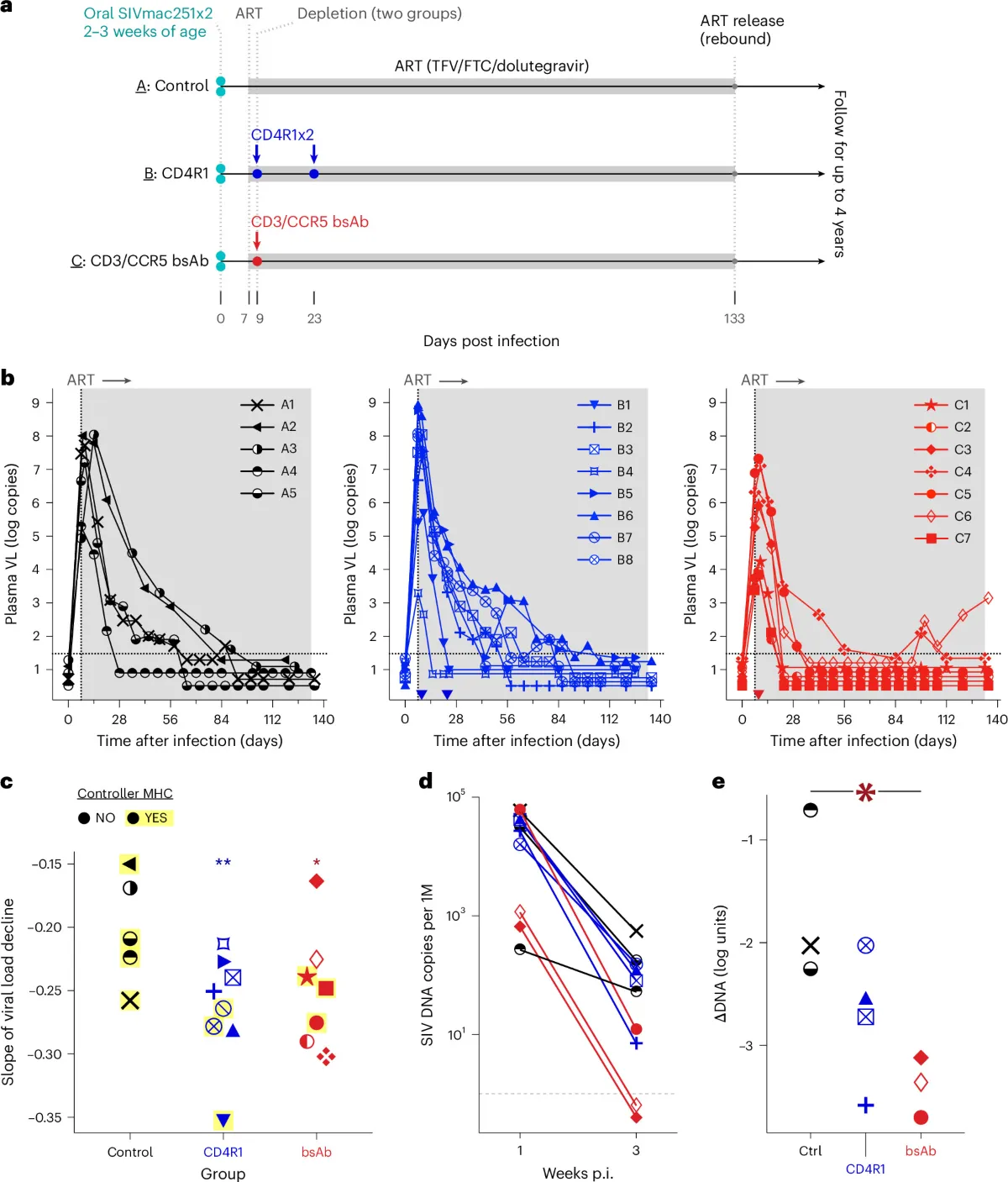
The infected animals were left alone for seven days so that the infection would become systemic and permanent. Then the animals were put on daily injections of three drugs: tenofovir, emtricitabine and dolutegravir. Two days after ART started, which was day 9 of infection, the groups diverged. Group A, the controls, simply continued ART. Group B received an antibody called CD4R1, which wipes out CD4-bearing cells, in two doses of 50 milligrams per kilogram of body weight, on days 9 and 23. Group C received one intravenous infusion of the CCR5/CD3 bispecific antibody at 3 milligrams per kilogram. ART was kept up until day 133, about 19 weeks after infection, and then withdrawn. After that, researchers tracked the animals for the return of virus for up to four years.
Early signs: faster decline, deeper drop
Before ART was stopped, the first signs that the antibodies were doing something showed up in the blood. In both antibody groups, the amount of virus in plasma fell faster than in the controls. The study's statistics found that the slope of the decline was steeper in both treated groups, with p-values of 0.009 for the CD4R1 group and 0.03 for the bispecific group. The authors caution that this could reflect the depletion itself or a secondary effect on how the virus spreads, such as the blocking of viral entry.
The more informative measure was cell-associated SIV DNA, which counts the copies of viral genes inside blood cells and therefore tracks the reservoir. In the newborns from which enough cells could be collected, the average fall over this period was 1.7 log units in animals that got ART alone. A log unit is a tenfold change, so 1.7 log units is a drop of roughly fifty-fold. Animals given the CD4-targeting antibody dropped by 2.7 log units, and those given the CCR5/CD3 antibody by 3.4 log units, which is more than a thousandfold. The difference favouring the bispecific antibody over the controls was statistically significant, with a p-value of 0.01.
One detail makes this number matter more. In this early stage of infection, 95% of the proviruses were intact. That means the DNA the assay was counting was mostly the kind that can, in principle, make working virus.
The team had a hint of this effect before the infant experiment. In a single juvenile macaque infected for ten weeks, one dose of the same antibody removed 71% of the intact proviruses in blood cells within two weeks, more than the change seen in any of ten controls. That suggested earlier treatment of a smaller reservoir would do better.
What one shot did to the immune system
The CD4R1 antibody did what it was built to do. It removed almost all CD4 cells from the blood, including about 100% of CD4-bearing monocytes and of CD4 T cells. The deficit lasted: in two of five animals, CD4 T cells were still substantially low twelve weeks after the first dose. CD8 T cells were not touched.
The bispecific antibody behaved differently, in two phases. First came a temporary loss of CD3-bearing T cells. Counts were lower at one and three weeks, then recovered by about four weeks. The authors suggest the dip may reflect T cells being pulled out of the bloodstream by the CD3 engagement, together with the intended destruction of CCR5 cells, though they say its cause is not settled. After that came the part the study was designed to produce: a specific, durable loss of cells that carry CCR5.
The depletion was nearly complete in the blood. No more than three CCR5-bearing CD4 memory T cells per millilitre of blood, and no more than five CCR5-bearing CD8 memory cells, were detected in any treated animal for at least 14 weeks after the antibody was given. Because the same antibody had earlier been shown to clear CCR5 cells from lymph nodes and colon, the blood result is not explained by cells simply moving into tissues. In some animals the relative depletion persisted for 34 weeks or longer after a single dose, although one macaque had recovered CCR5 expression by then.
The authors call the length of the effect "unexpected". CCR5 expression has been linked to T cell activation, which suggested it is dynamic and unlikely to be depleted for long by a single dose. The explanation they favour is that CCR5 expression is primarily a stable characteristic of certain cell lineages.
On safety, the paper reports that the animals tolerated treatment. Some animals in each antibody group had mild hypersensitivity-type reactions to the infusion, which resolved within hours; all had been given the antihistamine diphenhydramine beforehand. Body weight rose comparably across groups, and assays of inflammatory signalling molecules showed no significant difference between bispecific-treated animals and controls.
The day the drugs stopped
Everything above is a proxy. The real test is what happens when the drugs go. After 18 weeks of ART, treatment was withdrawn, and the researchers measured plasma virus repeatedly. "Rebound" was defined as the reappearance of more than 29 copies of virus per millilitre of plasma in an animal that had been fully suppressed.
In the control group, every animal was back within seven days. In the CD4R1 group, six of eight rebounded within the same week; the others took longer, and one never rebounded. In the bispecific group the pattern was different. The first two relapses did not come until day 13. Of the seven bispecific animals, four stayed without detectable virus for more than three months. One relapsed after 97 days and another after 173 days. A third had still not relapsed when follow-up ended at 29 weeks. The fourth, the one the team chose to follow long term, had not relapsed after four years. Whenever virus did return, in any group, it climbed to a set point above 10,000 copies per millilitre, and no animal showed later control.
The statistical model the authors used to take apart these results is informative. They looked at time to rebound with two predictors: the treatment group and the peak amount of virus in the blood during acute infection. Both mattered. Each tenfold decrease in peak viral load was associated with a 70% reduction in the risk of rebounding at any given time, and bispecific treatment with a 95% reduction. In the authors' reading, a limited initial burst of viral replication was probably required for the antibody to be able to delay rebound. In other words, the antibody effect came on top of a small initial infection, not instead of one.
Looking for a virus that may not be there
Three animals never rebounded: one given CD4R1 and two given the bispecific antibody. A long absence of virus in blood does not prove it is gone, as human cases cited in the paper show, so the team looked harder.
First, they used a more sensitive test for virus in plasma, a PCR assay able to detect as little as 4 copies per millilitre. It found nothing in any of the three animals. Second, they tried to force any hidden virus out by removing the immune system's defenders. Using a monoclonal antibody against CD8, they eliminated CD8 T cells, which suppress viral replication, from the blood of all three animals. If a surviving infection were being held in check by those cells, the infection should have reappeared. It did not. The authors conclude that CD8 T cells were not the main reason for the control, and that T-cell responses to SIV tracked with viraemia and were generally not measurable in the ART-only controls.
Third, two of the three animals, one from each antibody group, were necropsied so their tissues could be examined, while the bispecific recipient followed for four years was kept under observation. The researchers examined bone marrow, duodenum and colon, lung, spleen and lymph nodes from several sites. They used two methods. One was PCR for viral RNA and DNA. The other was in situ hybridisation, called RNAscope and DNAscope, which uses labelled probes to light up viral genetic material in thin tissue slices under the microscope. Between 125,000 and 750,000 cell nuclei were examined for each tissue. As a positive control, a viraemic bispecific-treated animal that had relapsed showed unambiguous viral nucleic acid in all six tissues assessed. Tissues from the non-rebounding animals showed none.
Fourth, the researchers tried to grow virus out of lymph-node cells. In a viral outgrowth assay, cells are stimulated strongly and cultured for weeks alongside cells that are susceptible to infection, and any virus capable of replicating should multiply. Lymph-node biopsies from two control animals did produce SIV, both when the controls were viraemic and when they were not. In the two non-rebounding animals that were examined, eight out of eight attempts failed, covering 47 million and 34 million cells tested.
There was one blemish, and the authors report it themselves. In the macaque followed for four years, a single sample taken at week 97 showed a possible trace of viral RNA, two copies in 91,304 cells, with no viral DNA and no virus in blood. The researchers say contamination could not be conclusively ruled out, though the amplification pattern looked right and the PCR product had the expected sequence. It is a reminder of how close to the limits of detection this kind of question sits.
How much of the reservoir was actually removed?
Most treated animals did relapse, so to estimate how much reservoir remained in all of them, the team used published mathematical models of rebound. The idea, developed in work by Alison Hill, Daniel Rosenbloom and colleagues, is that the time to rebound, taken together with viral outgrowth data, reveals how many infected cells exist: the larger the reservoir, the more often one of its cells wakes up and starts a new burst of infection, and the sooner the virus returns.
The model estimates the rate at which the remaining reservoir produces newly active infected cells each day. Controlling for peak viral load and for protective immune-system variants, the estimated reservoir was smaller in both antibody groups than in controls: significantly for CD4R1 (p = 0.02) and more so for the bispecific antibody (p = 0.0007). The regression estimated a 13-fold reduction with CD4R1 and a 152-fold reduction with the bispecific. A second, stricter adjustment for peak viral load, which the authors call an overcorrection, gave 20-fold and 219-fold. To put it another way, the bispecific antibody's effect was similar to starting out with a peak infection 460 times smaller.
These numbers invite scepticism, and the authors volunteer why. Modelling suggests that to delay rebound by a year in most people, the reservoir would have to shrink about 2,000-fold, and for three years of remission about 5,000-fold. Even depletion of 99.9% of CCR5-bearing cells in blood, and less in tissues, might seem unequal to that task. The authors call their finding "perhaps surprising", given that a 152-fold reduction falls far short of 2,000-fold.
Two ways to win: fewer reservoir cells, fewer places to land
The authors' explanation is that the mechanism of remission may involve two things at once. The first is the obvious one: eliminating infected cells. The second is depleting the cells that are vulnerable to infection by reactivated virus. A rebound is not just one cell waking up; the virus has to find new targets and spread, and the authors note that the rate at which reactivated virus finds new targets is a key parameter controlling rebound. In the authors' words, "reactivated virus finds no foothold among remaining immune cells, while the RCVR is gradually diminished due to toxicity of viral replication and/or attrition of the cells with time".
A related possibility is that the antibody works partly as an entry inhibitor, simply covering the CCR5 co-receptor so that the virus cannot use it. If so, the authors suggest, blocking CCR5 with binding antibodies or small molecules might also raise the chance of a post-treatment cure.
They also point to a human case that fits this picture. The "Chicago patient" received a stem-cell transplant from a CCR5Δ32/Δ32 donor. After a first interruption of ART the patient's virus rebounded to 780 copies per millilitre. After a further 22 months of treatment, the patient achieved more than ten months of ART-free remission, according to a conference report cited in the paper. The authors read this as ART becoming potentially curative in a person who has a persistent reservoir and few infectable target cells.
The same logic may explain why CCR5 was a better target than CD4 here. Depleting every CD4 cell removes the cells that fight the virus too. The paper cites two studies in which depleting CD4 cells before infection led to inability to control SIV, with set-point viral loads 100 times higher than in controls. CCR5, by contrast, is probably a good marker of the reservoir in early infection because CCR5-bearing cells are the first to be infected. The authors acknowledge that CCR5 has not been seen as a strong marker for the reservoir in later infection, and that most research on the reservoir has been done on people infected for a long time.
Where the claim stops
It is easy to run past the caveats, so here they are. The study is small: 20 infected animals in three groups, and seven in the group that got the bispecific antibody. The result is far from uniform: two of those animals relapsed within 13 days. Treatment began very early, a week after infection and two days after ART started, while the reservoir was still limited; the authors say the effect on adult SIV infection "may differ due to different viral dynamics and host immune function". And the infants were chosen because they can regrow T cells quickly.
Cure is a hard word to prove. The authors say three animals "appeared to have been potentially cured". A long absence of virus after treatment can still be followed by rebound, as human cases they cite show, and their own four-year animal produced that one ambiguous RNA signal. And every animal was infected with one virus stock, by mouth, at a high dose.
Then there is the safety question. This antibody removes every CCR5-bearing cell it can reach, whether or not the cell is infected, including CCR5-bearing CD8 T cells. The authors write that "in its current form, the CCR5/CD3 bsAb treatment raises concerns" and recommend testing for any increased susceptibility to opportunistic infection, and for any effect on the ability to control HIV when the infection cannot be cured.
"Our study demonstrates that targeting CCR5-expressing cells using the host immune system may be a surprisingly effective route to HIV cure, at least for infants that can be treated soon after infection."
That is the authors' own summary, and note its two qualifiers. "May be" is not "is". And "at least for infants that can be treated soon after infection" narrows the claim to the situation in which the experiment was run.
What would have to happen next
The scenario this experiment models is perinatal infection followed by early ART. Whether a single dose of a CCR5-targeting antibody could help a human infant is a question for further animal work and, eventually, careful trials. Nothing in this paper establishes that it would be safe or effective in a human infant, and the authors do not claim otherwise.
They do sketch a broader role. In their closing lines they note that even when this approach alone fails to clear the virus, the reservoir reduction and target-cell depletion it achieves "could enhance the efficacy of other immunotherapies in development". The authors suggest that the bispecific antibody might prove to be part of an effective integrated approach to depleting both active and latent reservoirs, "offering the promise of complete viral clearance to certain" people with HIV who harbour limited latent virus.
The follow-up questions are visible in the paper. Does it help when it is given later, when the reservoir is bigger, or in adults, whose viral dynamics and immune function may differ? Does it raise susceptibility to opportunistic infection? The data in hand cannot answer these.
What the paper does show is narrower and still remarkable. In a deliberately severe infection, a one-time antibody treatment, given on top of ART in the first days of infection, changed the outcome: virus returned within a week in every animal on the drugs alone, while in four of seven infants given the antibody it stayed away for more than three months. We covered the headline result in a short news report when the paper came out; our other coverage of the field is collected under the hiv-cure tag. Whether anything like it can work in a person is the open question.
Sources
- Deere, J. D. et al. SIV reservoir depletion and clearance from neonatal macaques following transient CCR5 depletion. Nature Microbiology (2026), open access, CC BY 4.0
- Merriam, D. et al. Depletion of gut-resident CCR5+ cells for HIV cure strategies. AIDS Research and Human Retroviruses 33, S70–S80 (2017)
- ScienceAlert: One Dose of Experimental Antibody Kept HIV-Like Virus in Remission For 4 Years in a Monkey
مزيد من المقالات
 ثعابين القصب القزمة تتدحرج بسرعة 3.7 م/ث وتُبقي رؤوسها ثابتة
- بوزيترون واحد في سيكلوترون كمي: اختبار CPT للمادة المضادة
- كيف يعيد الحبار كتابة الحمض النووي الريبي لإعادة تشكيل آلاف البروتينات