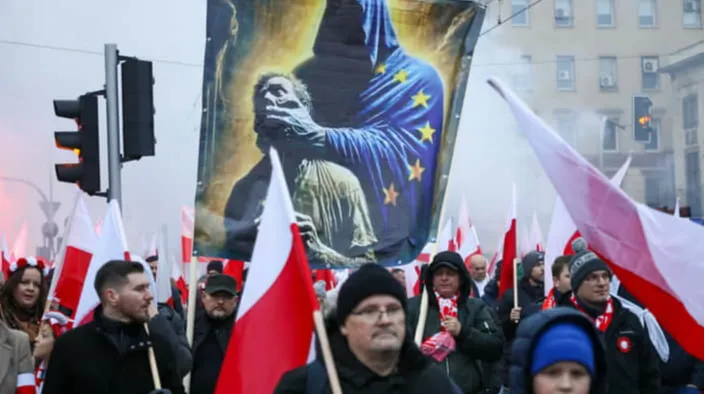
The Phantom of Polexit: How Real is the Threat of Poland Leaving the EU?
The specter of "Polexit"—Poland's potential departure from the European Union—continues to haunt the nation's political discourse. While a mass exodus is not immediately on the horizon, a growing undercurrent of euroskepticism, fueled by populist rhetoric and dissatisfaction with Brussels, is complicating Poland's political landscape.
A Nation Divided by Data
On the surface, Polish support for the EU appears ironclad. A January 2026 survey conducted by the CBOS research center reveals that an overwhelming 82% of respondents wish to remain within the bloc, compared to just 14% who advocate for an exit. When it comes to the future of the union, the public is evenly split: 25% support deeper integration, a similar proportion favors strengthening national sovereignty, and roughly a third prefer maintaining the status quo.
However, beneath these seemingly reassuring figures lies a deep societal fracture. Polls from Pollster and IBRIS indicate a troubling trend, showing that between 20% and 25% of Polish citizens now harbor anti-EU sentiments. This divide reflects traditional Polish polarization. Progressive, urban citizens with higher education and stable incomes advocate for closer ties with liberal Western Europe, particularly Germany. In contrast, conservative factions, often based in rural areas, view European liberalism as a threat and maintain a deep-seated distrust of Brussels, Berlin, and Kyiv.
The Vulnerability of the Right
Despite the high overall approval for the EU, some experts warn against complacency. Konrad Szymański, a conservative and former EU minister under the previous Law and Justice (PiS) government, voiced his concerns clearly. "I am not convinced by assurances that the path to an anti-EU breakthrough in Poland is still far away," Szymański stated, pointing to the "complete defenselessness of the right against anti-European resentment."
This resentment is being weaponized as the country looks toward the parliamentary elections scheduled for autumn 2027. The political arena is largely dominated by a fierce clash between the centrist Civic Coalition and the increasingly right-wing PiS. The upcoming campaign is expected to be a battle of narratives: the fear of EU overreach versus the fear of a disastrous Polexit.
Political Players and the Polexit Card
Currently, open advocacy for leaving the EU is rare among mainstream parties. According to Wojciech Szacki, an analyst at Polityka Insight, only the far-right Confederation of the Polish Crown, led by Grzegorz Braun, openly flirts with the idea. "This is not the key demand of this party, but it sounds out from time to time. I suspect that in this way they are trying to stand out from the others... and rally those voters who want to leave the EU," Szacki explains, though he notes that Braun's own electorate remains evenly divided on the issue.
Meanwhile, the largest opposition party, PiS, avoids direct calls for Polexit but has intensified its attacks on EU policies. The party vehemently opposes the European Green Deal, the EU emissions trading scheme, South American trade agreements, and the acceptance of funds from the SAFE program. Furthermore, Przemysław Czarnek, the newly selected PiS candidate for Prime Minister and a prominent figure in the party's radical wing, has previously warned that if the EU ignores Warsaw's demands, Poles could potentially organize a referendum on leaving the bloc.