Thick Tumor-Edge Fluid Makes Glioblastoma Cells More Invasive
The fluid around the outer edge of a glioblastoma is much thicker than the fluid near its centre, and new laboratory work suggests that this thickness does not simply slow cancer cells down: after long exposure the cells adapt in ways that make invasion easier. The study by researchers at Chongqing General Hospital and Chongqing University was published in Microsystems & Nanoengineering. It used cells grown in the lab, and further research is needed to show how the findings translate to tumors in patients.
An overlooked factor
Cancer research has mostly focused on chemical signals and tissue stiffness. In glioblastoma, one of the most lethal brain cancers, fluid at the tumor's advancing edge is about eight times more viscous than in the dead tissue at its centre, so cells moving outward meet growing resistance. Conventional closed microfluidic devices are poor at studying this, because enclosed channels can limit oxygen and nutrients and wall friction adds extra forces.
The chip
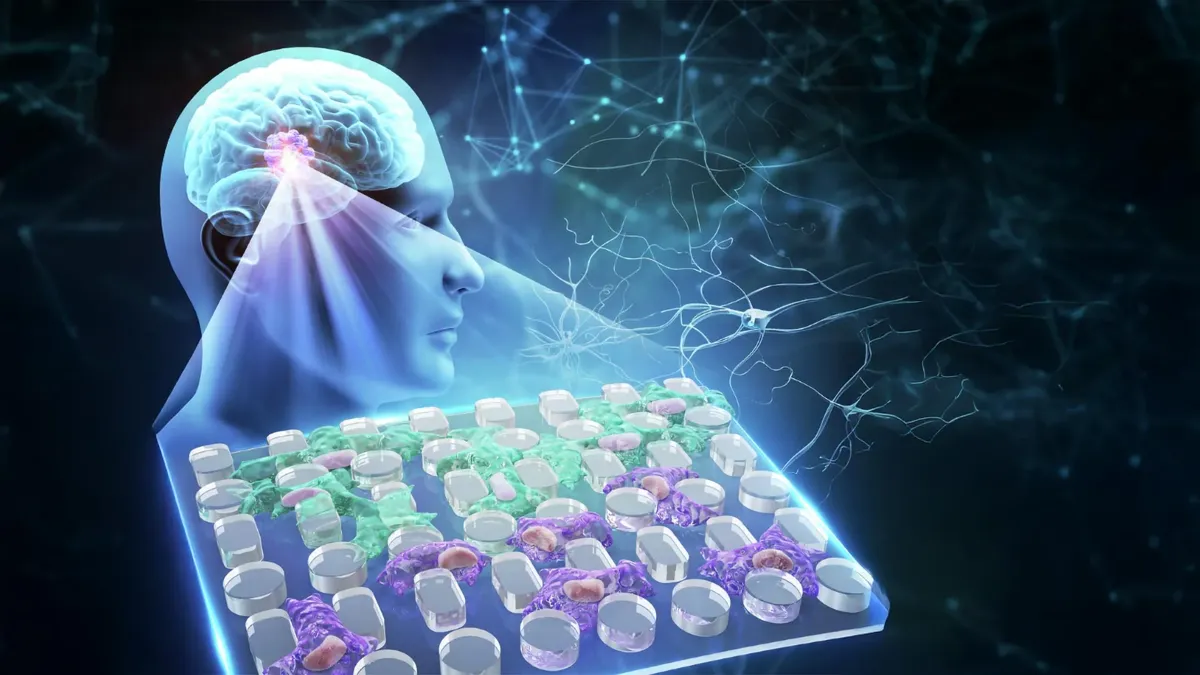
The team built an open microfluidic platform: a two-layer membrane with a removable cap and an array of tiny pillars. The cap lets researchers control when cells begin to migrate, and the pillars squeeze cells so changes in nuclear shape can be watched. The device supports continuous culture for up to a month and fits into standard multi-well plates.
Two human glioblastoma cell lines, U-251 and LN-229, were grown for a month in a thick fluid (7.1 cP) designed to mimic the tumor's invasive edge. On the chip, the adapted cells travelled faster and farther than untreated controls, which was surprising because thicker fluid would normally impede movement.
Smaller, more flexible cells
Adapted cells became smaller and easier to deform, so they squeezed between the pillars; their nuclei visibly deformed, and YAP, a protein that senses mechanical forces, accumulated in the nuclei. The two lines responded differently at the molecular level: U-251 cells underwent mesenchymal-like reprogramming, switching on invasion-associated genes including CD44, FN1 and MMP9, while LN-229 cells became more flexible and mobile without substantial lasting changes in gene expression.
Western blot analysis showed that protein changes remained after the cells were returned to fluid of normal viscosity, pointing to a kind of "mechanical memory". The researchers suggest the chip could be used to test drugs, for instance those targeting YAP signalling or remodelling of the cytoskeleton, in conditions closer to those inside tumors.
See also our Health section.