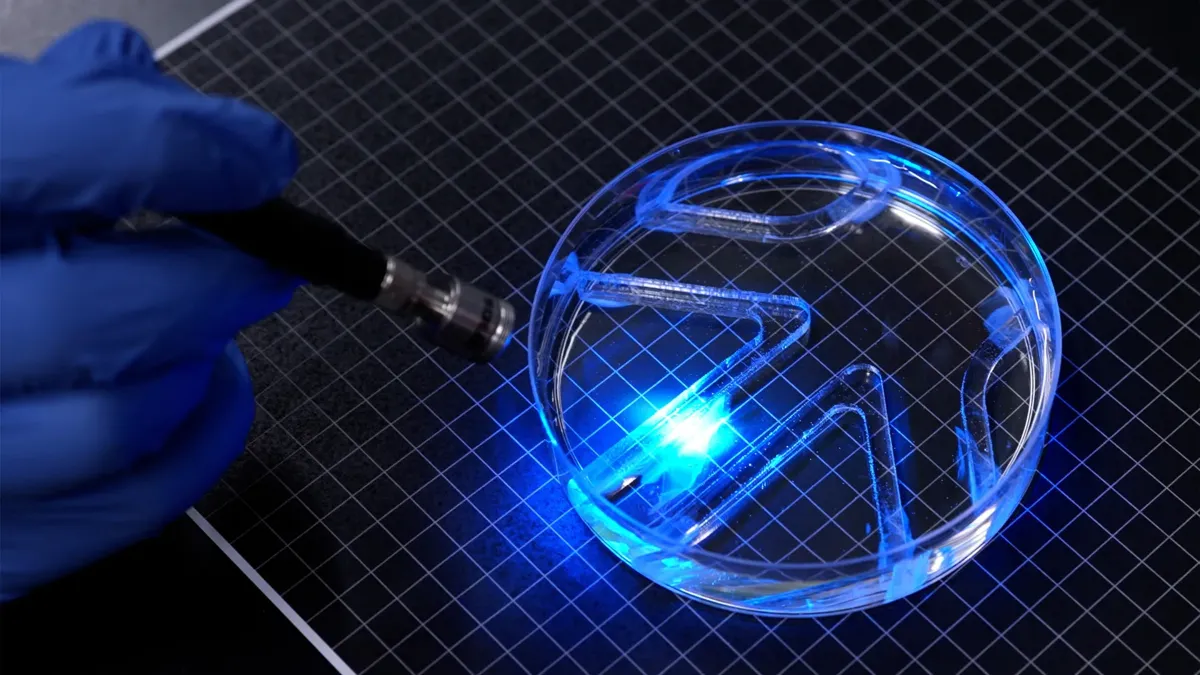
MIT Builds Tiny Swimming Robot Powered by a Thin Layer of Living Muscle
A swimming robot does not need a bulky motor to move through water. MIT engineers have shown that a single, carefully engineered layer of living muscle cells, thinner than a human hair, can produce enough force to push a tiny robot forward. The work is described in Advanced Functional Materials.
Two fins, two muscles
The device has a flexible gel frame roughly the length and width of a stick of gum. The gel forms two fins, each coated with muscle cells that have been genetically modified to contract when exposed to light. Shining light on one fin makes that fin flap and pushes the robot through the water; adjusting which fin is lit and how often controls speed and direction. "You can think of the robot as having two independent muscles," says study author Ritu Raman, associate professor of mechanical engineering at MIT. "If we shine a light on just one, only that muscle moves. If shining on both, they both flap."
In experiments in a large petri dish, the researchers moved a light source by hand and steered the robot through a simple underwater maze. At maximum speed it covered about four body lengths per minute. That is far below an Olympic swimmer, who can manage up to 65 body lengths per minute, but comparable to a cow shark cruising leisurely. "It takes a lot of force to move through water versus air," Raman says. "The robot's quite strong, given its size."
A thin, flat design
The robot is described as the first demonstration of a very thin, two-dimensional robot that moves from place to place using living muscle tissue. Most existing biohybrid robots rely on bulky three-dimensional chunks of lab-grown skeletal muscle that take millions of cells to make. Raman says thinner designs could be cheaper to build and move more efficiently.
Finding the right foundation for the muscle
The design builds on an artificial muscle disk the lab made last year, inspired by the human iris, in which a thin layer of cells grew along grooves patterned into a soft fibrin gel. That disk moved in several directions, but only about 100 microns. "From a robotics perspective, their movements were tiny," Raman says. The team found that fibrin could shrink quickly under the forces of the contracting cells, so for the swimmer they tuned three properties of the gel: its chemistry, stiffness, and the shape and size of the grooves.
They compared narrow channels with square profiles and longer channels with curved bottoms, and muscle cells aligned best in square grooves. Aligned cells are more likely to merge into fibers that contract together. The team swapped fibrin for gelatin methacrylate (GelMA), a material commonly used in tissue engineering, and tested formulations of different stiffness. Stiffer gels gave better alignment and stronger contractions. A film about half a millimetre thick offered a good balance: sturdy enough to carry a single layer of cells but light enough that contracting cells did not pull away from it. The engineers also "exercised" the muscle with repeated light pulses before building it into the robot, which strengthened the tissue.
What comes next
The robot's shape is still simple, and the aim of the experiment was to show that a very thin muscle layer can generate enough force to swim and steer. The team now plans to refine the body design for faster swimming. "Living tissue is soft, responsive to its surroundings, and can heal itself," Raman notes, and she imagines such robots one day doing delicate jobs in environments too fragile or unpredictable for conventional hardware, such as environmental monitoring in water. The Office of Naval Research provided partial funding.
More engineering stories are in our technology section.