Solar 'Artificial Leaf' Makes Hydrogen From Seawater and Breaks Down Toxic Hydrazine
Researchers at Nanyang Technological University (NTU) in Singapore have built a solar-powered device that produces hydrogen from seawater while breaking down hydrazine, a highly toxic industrial wastewater pollutant. The work is detailed in the journal Nature Communications.
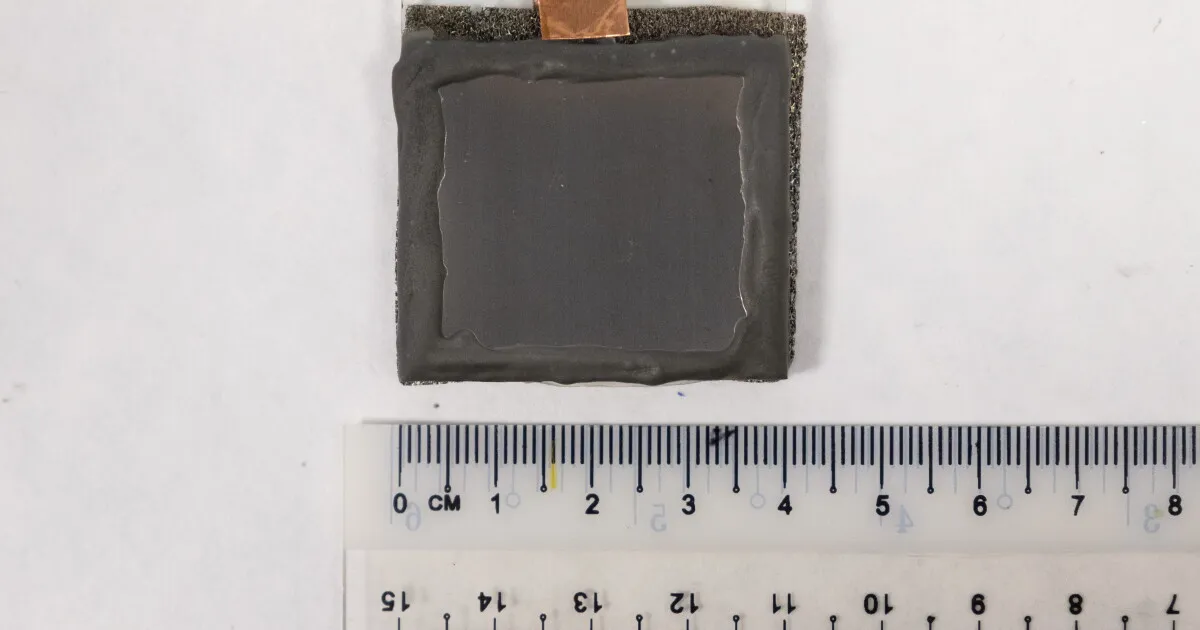
The team calls the proof-of-concept design an 'artificial leaf': it combines a miniature solar cell, an electrolyzer and a wastewater treatment system in one device. It is inspired by real leaves, which use sunlight to drive chemical reactions.
Two problems solved with one device
In tests, the device ran stably for more than 72 hours and produced hydrogen at a rate of 466 micromoles per square centimetre per hour. In a separate experiment, a larger version cut the concentration of hydrazine in contaminated water from 0.5 molar (about 1.6% by weight) to 0.5 parts per billion in about 30 hours. That is more than 20 times below the US Environmental Protection Agency limit of 10 parts per billion cited by the researchers.
"This dual-function device represents a major leap forward for environmental technology," said Prof. Lydia Wong, one of the researchers. "By efficiently harvesting solar energy to break down a toxic industrial pollutant while simultaneously harvesting clean fuel, we are solving both an energy problem and a pollution problem."
How the chemistry works
Electrolysis splits water into hydrogen and oxygen using electricity: hydrogen forms at the negative electrode (cathode) and oxygen at the positive one (anode). The oxygen is often just released, so a lot of energy goes into a 'waste' product. Seawater is attractive as a feedstock because it is abundant, but its chloride corrodes electrodes and can trigger reactions that produce toxic chlorine compounds.
The NTU team replaced oxygen production at the anode with the breakdown of hydrazine. A special catalyst turns hydrazine into nitrogen gas and also generates additional hydrogen. Breaking down hydrazine takes much less energy than making oxygen, so the hydrogen yield at the cathode becomes more energy-efficient. The catalyst contains iron, cobalt and chromium, which makes it corrosion-resistant and helps suppress toxic chlorine compounds.
A perovskite cathode that powers itself
The cathode is made of lead-halide perovskites, semiconductors that absorb light and convert it into electricity. This allows the device to run without an external power supply. Perovskites are vulnerable to moisture and harsh chemicals, so the researchers shielded them with a layer of conductive epoxy containing silver and copper particles and a titanium foil that keeps water out while letting charge pass. The titanium was coated with a thin layer of platinum to help produce hydrogen.
Test conditions and results
The device was placed in alkaline solutions of simulated and real seawater with hydrazine added, under artificial light equal to the intensity of sunlight on a clear day. In both cases it generated a photocurrent density of about 25 milliamps per square centimetre, among the highest reported for lead-based perovskite photocathodes, with no external electricity. For the hydrazine test, the team enlarged the photocathode from 0.56 to 6.25 square centimetres. They also ran the leaf outdoors in natural sunlight and saw hydrogen and nitrogen bubbles forming, showing that it can operate outside laboratory lighting.
The results come from a laboratory prototype, not a commercial system. See more in our technology section.