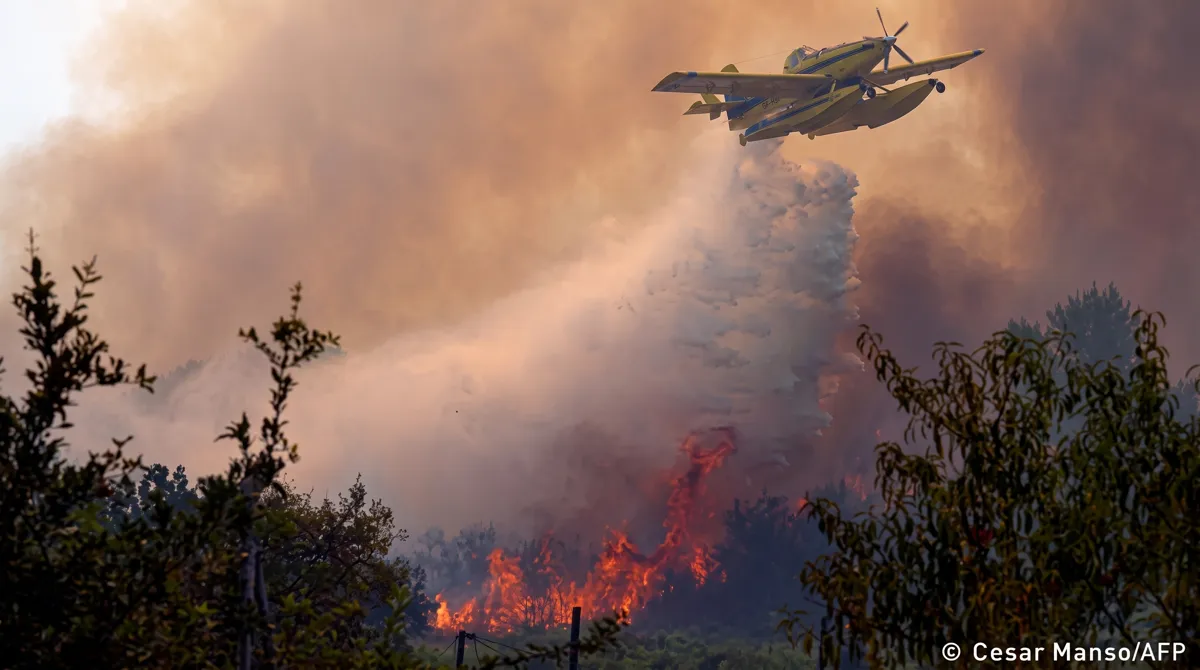
Spain Wildfires Cost Billions as Economy and Tourism Suffer
Spain is grappling with the economic fallout of its worst wildfire season in decades. According to the EU's Copernicus Earth Observation System, 206,000 hectares of forest have already burned across the country in 2026. The fires are not only destroying nature — they are choking the Spanish economy.
Billions Lost: The Scale of Wildfire Damage
A comparison with 2022 illustrates the financial stakes. When roughly 300,000 hectares burned that year, the European Commission calculated total economic damage at approximately €7.1 billion, according to economist Emilio Vizuete Luciano of the University of Barcelona. Tourism, one of Spain's most vital industries, suffers heavily whenever fire reaches popular regions.
"When tourism disappears from fire-affected regions, it has serious economic consequences for all of Spain," said Vizuete Luciano.
GDP Growth Dragged Down by Flames
Climate economist Sarah Meier of ETH Zurich studied economic losses from wildfires across southern Europe. Her 2023 study found that regions experiencing at least one wildfire saw their growth rate fall by 0.11 to 0.18 percentage points. In areas hit by multiple simultaneous fires, depending on the scale, the growth loss could reach 4.5 percent.
"Our calculations are an average over the period from 2011 to 2018," Meier noted, adding a warning: "It becomes particularly costly when fires reach larger cities — something that has so far been very rare in Southern Europe."
Could Spain Have Reduced the Damage?
Experts have pointed to years of underinvestment in forest management and climate adaptation as key factors amplifying the destruction. The European Environment Agency (EEA) has independently calculated the economic losses from past wildfires, reaching similar conclusions about the growing financial burden on southern European economies.
Spain's wildfire crisis is part of a broader pattern across the Mediterranean. France too has been battling record fires this season, with one of the largest evacuation operations in its history underway in the southwest.