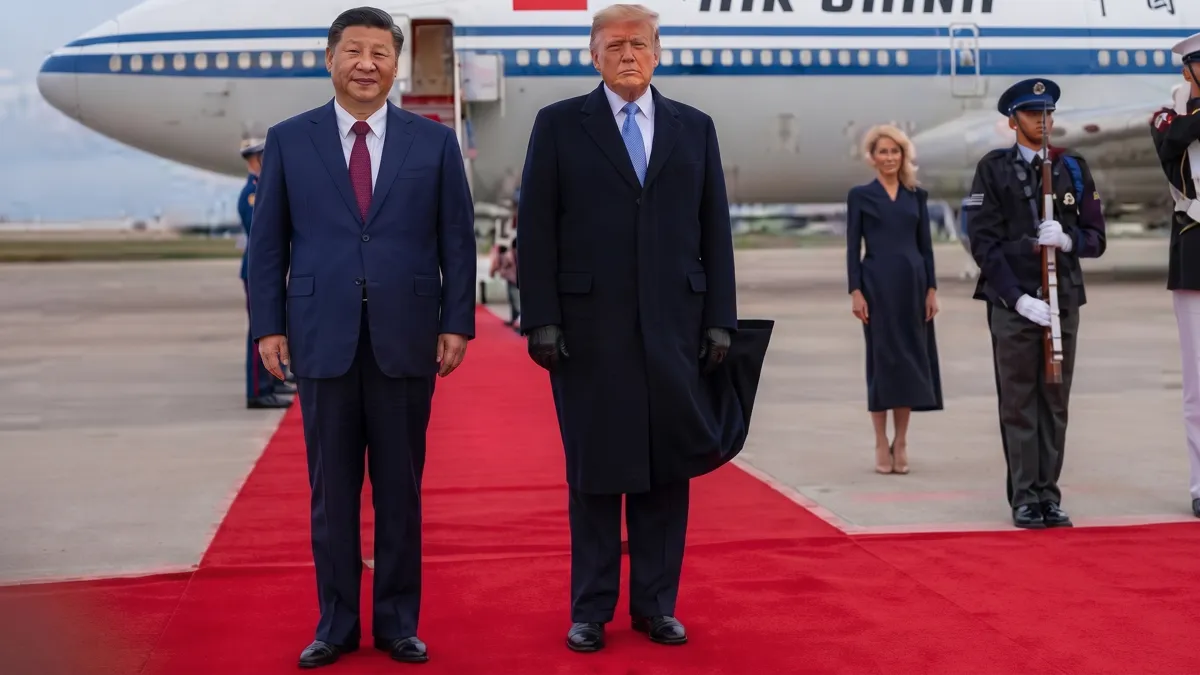
Xi Jinping and Trump Reach Brief Trade Truce at Washington Summit
Chinese President Xi Jinping and US President Donald Trump held a landmark summit in Washington this week, agreeing to only a brief extension of their trade truce while deep divisions over tariffs, technology controls, and Taiwan remained stubbornly unresolved.
The talks were driven by Beijing's persistent conviction that Washington is pursuing a deliberate campaign to contain China's rise as a global superpower. Xi came to the table seeking American concessions on three fronts: the trade barriers hammering Chinese exports, US export restrictions on advanced semiconductor chips central to China's technology ambitions, and arms sales to Taiwan that Beijing views as a direct challenge to its sovereignty.
The trade outcome proved modest. Both governments agreed to extend their existing truce from November through January — well short of the year-long reprieve Beijing had sought. Fundamental disputes over tariff levels, China's commanding hold on global rare earth mineral supplies, and American curbs on cutting-edge chip exports were left entirely unaddressed.
Xi's bargaining position is complicated by serious pressures at home. Youth unemployment has climbed to troubling levels, the property sector has contracted sharply, and cautious consumers are pulling back on spending — conditions that make a prolonged trade conflict an increasingly costly prospect for Beijing.
Taiwan loomed large over the diplomatic proceedings. Xi reiterated that US arms transfers to the self-governing island represent a firm red line for China. Trump announced a delay to a $14 billion arms package earmarked for Taipei, framing the postponement as a valuable negotiating chip with Beijing — language that stirred concern among Washington's regional allies who view arms sales to Taiwan as essential to deterrence.
Looking ahead, both leaders committed to participate in a series of upcoming regional summits. China will host the Asia-Pacific Economic Cooperation forum in November, while the United States is set to convene the G20 in Florida later this year.
Analysts cautioned that beneath the ceremonial trappings, the summit managed rather than resolved the structural competition between the world's two largest economies. No concrete roadmap was agreed for tackling the most contentious issues dividing Washington and Beijing.