How an Ancient Virus Silenced a Brain Gene in Chimpanzees
An ancient virus that infected only chimpanzee ancestors silenced a human brain-development gene. What the CRISPR and organoid tests prove, and what they don't.
Two dishes sit side by side in a stem-cell lab in Lund, Sweden. In one, a few hundred thousand cells have folded themselves into tiny balls of early brain tissue, grown from a human donor. In the other, the same recipe has produced the same kind of balls from a chimpanzee. After fifteen days the two look almost identical under the microscope: the same ring-shaped neural rosettes, the same mix of young cells, the same markers lighting up in the same places.
Then the researchers read out which genes are switched on. In the human balls, one gene is busy. In the chimpanzee balls, the same gene is completely silent, as if someone had pulled out its plug. Nothing in the gene's own sequence explains it. What explains it is a stretch of foreign DNA, about seven thousand letters long, that sits inside the gene in chimpanzees and nowhere in us: the fossil of a virus.
The study, from Johan Jakobsson's group at Lund University with colleagues in Gothenburg, Uppsala, Minnesota and Seattle, appeared on 23 October 2026 in Science Advances. Its headline claim is cautious but striking: an ancient retrovirus that infected chimpanzee ancestors, and never ours, left a mark that still keeps one human-specific brain gene off in chimpanzee cells. We reported the result on release day. This story looks at how the experiment works, why the evidence is stronger than a headline can show, and where it stops.
Nearly the same genes, very different brains
The puzzle is old. A human brain is roughly three times the size of a chimpanzee's, with more neurons in the cortex and more connections between them. Yet humans and chimpanzees share more than 96% of their protein-coding sequences. If the recipes for the building blocks are nearly the same, the difference must lie somewhere else.
Biologists have been looking for it in the part of the genome that does not code for proteins: the switches, dimmers and bookmarks that decide which genes are read, when and how loudly. That noncoding territory is huge and hard to read. One of its largest components is made of transposable elements, DNA sequences that can copy themselves into new places. Earlier work, including work from the same Lund group, had already tied some of these sequences to human-specific gene activity in the developing brain. But, as the new paper puts it, the contributions of such elements to primate brain speciation "remain largely unexplored."
Among transposable elements, one family has a particularly vivid origin story. Endogenous retroviruses, or ERVs, are the leftovers of real infections.
How a virus becomes part of the genome
A retrovirus copies its genetic material into the DNA of the cell it infects. Usually that cell dies with the host, and the viral DNA goes with it. But once in a rare while the infected cell is an egg, a sperm or an early embryonic cell. Then the viral DNA is inherited like any other stretch of the genome. If the carrier lineage survives, the insertion can spread through the whole population and become fixed, the same in every individual.
This happened many times in primate history. At least 8% of the human and chimpanzee genomes consists of such remnants, either whole proviruses or just the short sequences at their ends. Comparing the two genomes shows which pandemics hit which lineage. In the roughly five to seven million years since our ancestors split from those of chimpanzees, only a small number of one retrovirus group, HERV-K, settled into the human genome. The chimpanzee lineage was invaded by something far bigger.
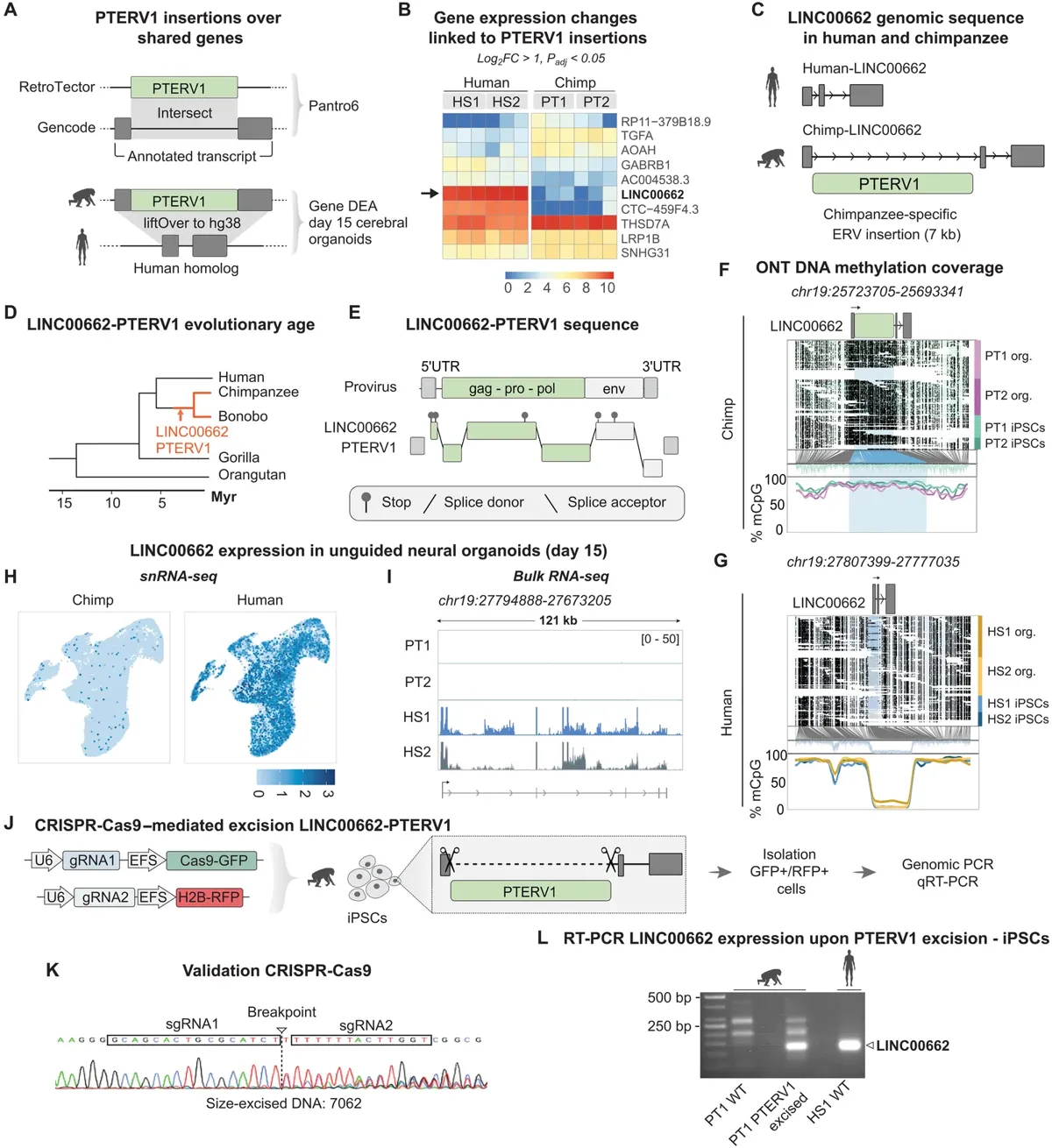
That something is PTERV1, short for Pan troglodytes endogenous retrovirus 1. The new paper counts 158 PTERV1 elements in the chimpanzee reference genome, ranging from 2 to 14 thousand letters long, which makes it one of the most abundant ERV families there. PTERV1 is also found in bonobos and gorillas, but almost never in the same places: only one insertion is shared between the chimpanzee and gorilla lineages. That pattern suggests the virus kept re-invading each lineage on its own. In humans, it is absent entirely.
Why we were spared is not settled. The authors point to two possibilities. One is geography: our ancestors may simply not have shared a habitat with the infected apes. The other is biology: each primate species makes a version of an antiviral protein called TRIM5α with different targets, and earlier work the paper cites showed that the human version blocks PTERV1 from infecting human cells. Either way, a pandemic that rewrote chimpanzee DNA passed us by.
A pandemic of this kind is costly for the species that suffers it. The authors note it likely pushed the ancestors of chimpanzees and bonobos through a population bottleneck. A modern parallel is unfolding in Australia, where the koala retrovirus KoRV-A is spreading between wild koalas while also entering their germ cells, and where it has come with a heavier disease burden, including a high prevalence of cancers. Endogenization, as this process is called, is rare enough on evolutionary timescales that PTERV1 is one of the few cases researchers can still study in the genome record.
A way to look at a brain nobody can sample
Comparing the developing brains of humans and chimpanzees has a practical problem: nobody can take early chimpanzee brain tissue. For years this blocked the whole field. The workaround is induced pluripotent stem cells, or iPSCs. Researchers take ordinary skin or blood cells and reprogram them with a cocktail of factors until they behave like embryonic stem cells, able to become almost any tissue. Chimpanzee iPSC lines made by other laboratories now exist, which is what opened the door for this study.
The Lund team used two human lines and two chimpanzee lines, one female and one male of each, and pushed them all through a single protocol for so-called unguided neural organoids. "Unguided" means the cells are not steered toward any particular brain region; they self-organise into a mix of early neural tissue. The team tuned the protocol so the human and chimpanzee organoids grew under near-identical conditions. By day 15 they had the same size, the same shape and the same neural rosettes. Single-nucleus RNA sequencing, which reads the active genes in each individual cell nucleus, showed the same cell types in both species: mostly neural progenitor cells and young neurons.
That matching is the quiet foundation of the whole result. If chimpanzee organoids had grown poorly or differently, any gene difference could be blamed on the culture dish. Because the organoids were so alike, a gene that is on in one species and off in the other is hard to dismiss as an artefact.
The second technical ingredient was long-read DNA sequencing on Oxford Nanopore instruments. The machine threads single DNA molecules through a tiny pore and reads not only the letters but also chemical tags on them, including the methyl groups that mark DNA as "silenced." Because the reads are long, they can cover an entire inserted virus and its neighbourhood at once, resolving methylation at individual letters instead of averaging over thousands of cells.
158 islands of silence
The first thing the sequencing showed was that almost every PTERV1 copy in chimpanzee stem cells and in day-15 chimpanzee organoids was fully methylated. Methylation is the cell's way of locking away DNA it does not trust. Viral leftovers are a prime target, because a reactivated virus is dangerous. Primate genomes have an elaborate defence squad for this job: a huge family of DNA-binding proteins called KRAB zinc-finger proteins (KZNFs), which recognise transposable elements and recruit a partner protein, TRIM28, that builds a compact, silent chromatin structure over them.
The authors have not yet identified which KZNF recognises PTERV1, so that part of the story is a model rather than a measurement. But the outcome is measured: 158 chimpanzee-specific islands of closed chromatin, none of which exist in the human genome. They are, in the authors' phrase, species-specific heterochromatin domains. The defence has a side effect. A mark meant to hold a virus quiet can leak onto the DNA next door.
There was also a hint that evolution has been quietly policing this invasion. Most PTERV1 copies sit between genes. Where they do land inside a gene, they point mostly in the opposite direction to the gene, which is the orientation least likely to disrupt it. Copies that interfered more heavily were presumably weeded out. The authors read this as a sign of purifying selection.
Hunting for the gene that went quiet
Islands of silence are only interesting if they land near something. So the team asked a narrow question: which genes that exist in both species contain a PTERV1 insertion entirely within their body? The answer was 45 genes. They then checked which of those behave differently in human and chimpanzee organoids, using bulk RNA sequencing and a standard threshold: at least a twofold difference in activity, with statistical significance. Ten genes passed, protein-coding and noncoding alike, most with the virus tucked into an intron, a non-coding stretch inside the gene.
The top candidate was a gene called LINC00662. It does not make a protein. It makes a long noncoding RNA, or lncRNA: a molecule that is copied from DNA and then does its work as RNA, without ever being translated. In human organoids LINC00662 was highly active. In chimpanzee organoids it was completely silent. The other nine genes were intriguing in their own right; the paper lists, for example, a gene for a subunit of the GABA-A receptor, tied to synaptic signalling and, in the literature the authors cite, to schizophrenia. But LINC00662 had the cleanest on-off contrast.
Then came the check that is easy to skip in a news summary and hard to fake in a lab: is this a quirk of two chimpanzee cell lines? The authors went back through public data. LINC00662 is active in human cell models but silent in chimpanzee, bonobo, orangutan and macaque neural cells. Induced stem cells from eight additional chimpanzee individuals told the same story. And human tissue data from the GTEx project show the gene is read broadly across the body, with higher activity in the brain and testis.
Anatomy of a viral fossil
The chimpanzee version of the LINC00662 locus carries one large difference from the human version: an inserted PTERV1 provirus of 6,915 letters, lying in the gene's first intron. When the researchers aligned the two sequences, they found no other major differences there. In genetics, that is as close to a suspect with no alibi as it gets.
Complete telomere-to-telomere genome assemblies of great apes let the team date the event roughly. The insertion exists in chimpanzees and bonobos but not in humans, so it happened after the human line split off and before chimpanzees and bonobos parted ways, somewhere between about 1.5 and 5 million years ago. The two ends of the provirus, which are identical at the moment of insertion, differ by only 1.2%, confirming that the insertion is young in evolutionary terms.
The neighbours tell their own story. In gorillas and macaques the whole 300-thousand-letter segment containing LINC00662 is absent. Orangutans have the gene region but carry a different transposon, an 8.8-thousand-letter LINE-1 element, upstream of it. The authors conclude that only the human genome has a functional LINC00662 unit. The gene is, in that sense, a human-specific transcript, not a chimpanzee gene that was lost.
The virus itself is dead. Its genes for the core proteins and the envelope are riddled with frameshifts and premature stop signs, so the provirus is almost certainly unable to make new virus. It is an inert fossil. Dead does not mean harmless, though: its DNA is still there to be recognised and locked down.
And locked down it is. The nanopore reads showed the inserted virus in chimpanzee cells is heavily methylated, and so are the flanking regions. In human cells the same locus is almost unmethylated. A mark that is chemically attached to the virus appears to have spread into the gene's own start site. A further layer of evidence points the same way. In human neural progenitor cells the start site of the gene carries H3K4me3, a histone modification typical of active promoters; in chimpanzee cells that mark is missing and methylation sits there instead.
The rescue experiment
Correlation is not proof. The decisive step was to remove the virus and see whether the gene wakes up. The team designed two guide RNAs aimed at the unique DNA on either side of the insertion and delivered them with the Cas9 enzyme into chimpanzee stem cells using lentiviral vectors. Cas9 cuts at both sites, and the cell repairs the break by joining the outer ends, leaving out the stretch in between. Amplicon sequencing confirmed that the roughly seven-thousand-letter provirus had been excised.
Then the readout. In edited chimpanzee cells, LINC00662 was expressed. The gene that had been silent in every chimpanzee sample came on, with nothing else in the locus changed.
"This shows that it is in fact the viral insertion that is responsible for the gene being switched off in chimpanzees." — Patricia Gerdes, postdoctoral researcher at Lund University and the paper's first author, in the university's press release
It is worth being exact about what this settles. It settles that the PTERV1 insertion is the cause of LINC00662's silence in these cells. It does not settle whether this had consequences for chimpanzee brains. Gerdes was explicit about that when she spoke to ScienceAlert: removing the insertion "does not show that removing it would transform brain development," and doing so in an adult brain "would not undo the brain's earlier development." The experiment was done in stem cells in a dish, not in neurons, let alone in an animal.
What the gene does in a human brain
If a gene is human-specific and silenced in chimpanzees, the natural next question is what it does in us. Here the paper moves from evolution to cell biology. Public data show that LINC00662 activity in the human brain peaks very early, around 10 to 12 weeks after conception, and declines gradually into adulthood. The team confirmed expression in fetal forebrain tissue at 7 and 11 weeks, and used long-read RNA sequencing on fetal brain at 9 and 10 weeks to show the gene is spliced and produces several versions of the molecule.
Where the molecule sits in the cell hints at its job. Some lncRNAs act on the DNA near where they are made; others work far from it. Cell fractionation showed LINC00662 is found almost exclusively in the cytoplasm, outside the nucleus, so it works away from its own gene. To find out what it works with, the researchers used biotin-tagged DNA probes to fish out the molecule along with whatever was stuck to it, then identified the proteins by mass spectrometry. A probe aimed at a sequence absent from the human genome served as the negative control.
The proteins caught on the molecule were enriched for functions in axon extension and neural development. Examples include FLNA, MYH10, nestin, vimentin and DPYSL2, all part of the cell's internal scaffolding, the cytoskeleton, and all linked in the literature to the way young neurons push out their branches. In plain terms, LINC00662 seems to hang out with the molecular machinery that lets a newborn neuron grow its wiring.
Switching it off in human organoids
To test whether the association means anything, the team did the mirror image of the rescue. They silenced LINC00662 in human cells using CRISPR interference, a variant that does not cut DNA but parks a repressor on the gene's start site. Because the repressor domain is the same one the cell uses to lock away transposons, it also raised methylation across the locus, which the authors note mimics the epigenetic state of the chimpanzee version of the gene. Silencing was nearly complete.
In human neural progenitor cells with the gene off, FLNA, MYH10 and nestin shifted their location inside the cell, with more of each in the cytoplasm. The authors read this as LINC00662 normally destabilising these proteins there. That is an interpretation of imaging data from a few dozen cells per condition, and the paper itself treats it as suggestive rather than definitive.
The organoids tell a more concrete story. The team grew silenced and control organoids for 15 and 30 days. At 15 days, they were indistinguishable. At 30 days, when newborn neurons normally begin to send out their first extensions, silenced organoids showed markedly weaker staining for TUJ1, a protein of young neurons' internal skeleton, in the zone where those cells sit. The rosettes themselves, made of progenitor cells, looked the same. A second marker, MAP2, trended the same way but did not reach statistical significance.
Single-nucleus sequencing of 119,674 nuclei from 85 organoids, 61 silenced and 24 control, showed that the gene's absence did not change which cell types appeared. What it changed, at day 30, was the activity of genes tied to growing axons and dendrites. Perhaps surprisingly, many of them were turned up, not down, among them NOTCH1, CDH4, SLIT3 and KALRN. The authors suggest a compensatory feedback: neurons that struggle to extend their branches may raise the activity of branch-growing genes in response. They say candidly that they do not fully understand it.
The picture that emerges is of a gene that does not decide what a neuron becomes but affects how well it matures once it exists. That is a modest role. It is also precisely the sort of role the field has long suspected matters for human brains: the authors note that their results support the idea that differences in how dendrites and synapses mature help produce human-specific brain functions.
Would a human with the insertion have a chimpanzee brain?
The question every reader will ask is the obvious one: would a human with this insertion have a chimpanzee-like brain? The authors do not claim that, and the lead author spelled out why. Speaking to ScienceAlert, Gerdes said that if humans had the same insertion it "probably would have switched off LINC00662 and altered the development of brain cells." But she added: "we cannot predict that this would produce a particular brain shape, ability, or behavior. The effect could also depend on the surrounding human DNA and other genes."
That caution is built into the data. The organoids were small, early-stage models grown for no more than a month. A loss of LINC00662 reduced one marker of neuronal maturation in a particular zone of those organoids; no experiment measured brain size, folding or cognition. The knock-down was done in human cells, because the gene is human-specific; no one has yet put the gene back into chimpanzee neurons to see if they mature differently.
There are also open mechanistic questions the authors name themselves. Which KRAB zinc-finger protein recognises PTERV1 has not been found. Exactly how the insertion's silence spreads into the neighbouring promoter needs further molecular work. And lncRNAs are notoriously hard to study in dishes, which the authors say limits the interpretation of many comparative studies of human and chimpanzee neurons derived from stem cells.
The study's own data suggest LINC00662 is an example rather than the explanation. The authors found 158 PTERV1 islands and 45 genes with an insertion entirely inside them, of which ten differed between species. Another of them, LRP1B, has been linked in the literature to several cancers. The authors conclude that the influence of PTERV1 on gene regulation in chimpanzees may be broad, and note that spread of methylation into neighbouring genes has been documented for other classes of repeats in many species.
The most careful reading is therefore a modest one, and an interesting one. The retroviral pandemic that struck chimpanzee ancestors had at least two kinds of effect. First, it probably squeezed the population through a bottleneck, in the authors' view. Second, it left behind more than 150 fixed insertions, some of which can change how nearby genes are controlled. Together, these effects may have shaped how the chimpanzee and human lines diverged. The work offers one experimentally traced instance of the second effect; it does not claim to quantify its importance.
The Lund group says its next steps are to investigate whether other viral remnants have had similar effects during the evolution of the brain, and whether this type of DNA sequence is also linked to brain diseases. The second part is more than a footnote. Jakobsson, a professor of molecular neurogenetics, adds in the press release that the work helps our understanding of how gene regulation can protect or cause damage to the brain, among other organs.
There is a technical lesson too. The study shows how far a combination of three tools can go: stem-cell models, nanopore reads that expose methylation along entire viral insertions, and precise genome editing. Each of them has been available for years. Used together on a chimpanzee virus, they could trace a line from a fossil in the DNA through a silent gene to a measurable change in how young human neurons mature.
The takeaway
The popular version of this story is that a virus made chimpanzees what they are. The accurate version is smaller and sturdier. Millions of years ago, a retrovirus invaded chimpanzee ancestors. The cell's defences locked its leftovers away, and in one place that lock reached over to a neighbouring gene. In the Lund experiments, removing the leftover brought the gene back, and silencing the same gene in human organoids slowed one step of neuronal maturation. What this means for real brains is still open.
What makes the finding worth following is the direction it opens. Human brain evolution has often been told as a story of new genes and bigger brains. This study adds the possibility that some of what makes us different is a matter of what we did not catch: a pandemic that missed our line, and a silenced gene that stayed free in ours. You can read more of our science coverage in the Science section.
Sources
- Gerdes P. et al., "Retroviral insertions contributed to the divergence of human and chimpanzee brains," Science Advances, 23 October 2026 (DOI 10.1126/sciadv.aeg5791; open access, CC BY)
- Lund University press release, "An ancient virus in chimpanzee DNA switches off a gene that is active in humans," 23 October 2026
- ScienceAlert, interview with Patricia Gerdes, 24 October 2026