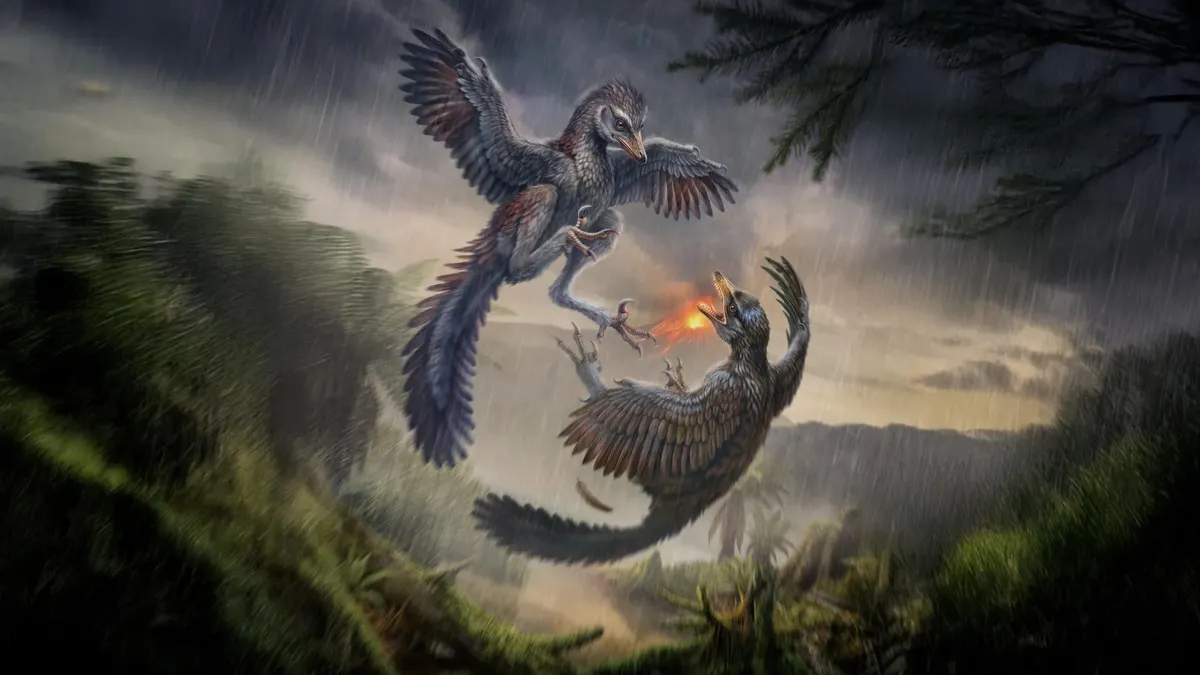
Flightless Jurassic Bird With Raptor Teeth and Claw Found in China
A crow-sized bird that lived about 150 million years ago in what is now southeastern China appears to be the earliest known bird lineage that lost the ability to fly. The fossil, named Yuezhuornis yangyuanensis, was described in the journal Nature, published on 14 October.
It was found by researchers from the Institute of Vertebrate Paleontology and Paleoanthropology (IVPP) of the Chinese Academy of Sciences and the Fujian Institute of Geological Sciences in the recently recognised Zhenghe Fauna of Fujian Province. The bird lived in the Late Jurassic, 150 to 148 million years ago.
A bird with dinosaur teeth and claws
Yuezhuornis mixes features of birds and of small predatory dinosaurs. It had bird-like pelvic and hindlimb structures, but its jaws held closely spaced, serrated teeth resembling those of deinonychosaurs, a group of meat-eating dinosaurs related to birds. Its second toe could bend backward unusually far and carried a curved, sickle-shaped claw, a feature strongly associated with deinonychosaurs, including dromaeosaurids and troodontids.
"When we examined Yuezhuornis, we were struck by its extraordinary mix of features," said Dr. Min Wang, the study's corresponding author. "It shows us that early bird evolution was far more complicated than we previously realized."
Where it sits on the family tree
To place the animal among its relatives, the scientists compared its anatomical characteristics using two methods. Maximum parsimony picks the relationships that require the fewest changes in traits. Bayesian tip-dating adds statistical estimates of evolutionary history and the ages of the fossils. Both methods gave consistent results and put Yuezhuornis within Avialae, the group that contains modern birds and their closest extinct relatives.
"The results consistently placed Yuezhuornis firmly within Avialae, just crownward of Archaeopteryx and as a sister taxon to Zhengheornis," said co-author Dr. Zhonghe Zhou. Archaeopteryx also lived roughly 150 million years ago and is among the most famous early bird relatives.
Evidence that it did not fly
The team measured the skeleton's proportions and compared them statistically with other animals to judge whether the body was built for flying or for moving on the ground. The limb proportions of Yuezhuornis closely resembled those of modern ground-dwelling birds and of certain prehistoric dinosaurs close to birds. This suggests that it spent its life on the ground and was likely unable to fly.
According to the authors, the finding challenges the assumption that early bird evolution was driven mainly by the demands of flight. Even in the Late Jurassic, some lineages were already adapting to life on land, and early birds were more anatomically and ecologically diverse than previously recognised. The Zhenghe Fauna may help researchers understand this poorly known period.
The study is by Liming Xu, Min Wang and colleagues, Nature, 2026, DOI 10.1038/s41586-026-10972-z. More discoveries are in our science section.