Balloon Telescope Finds Hidden Magnetic Threads Above the Sun's Quiet Regions
Scientists have found a surprisingly complex network of thin magnetic structures above regions of the Sun that look calm. An international team led by the National Astronomical Observatory of Japan (NAOJ) used the Sunrise-III solar observatory, flown on a balloon high in Earth's stratosphere in 2024, and reports the result in The Astrophysical Journal Letters.
A web of magnetic threads
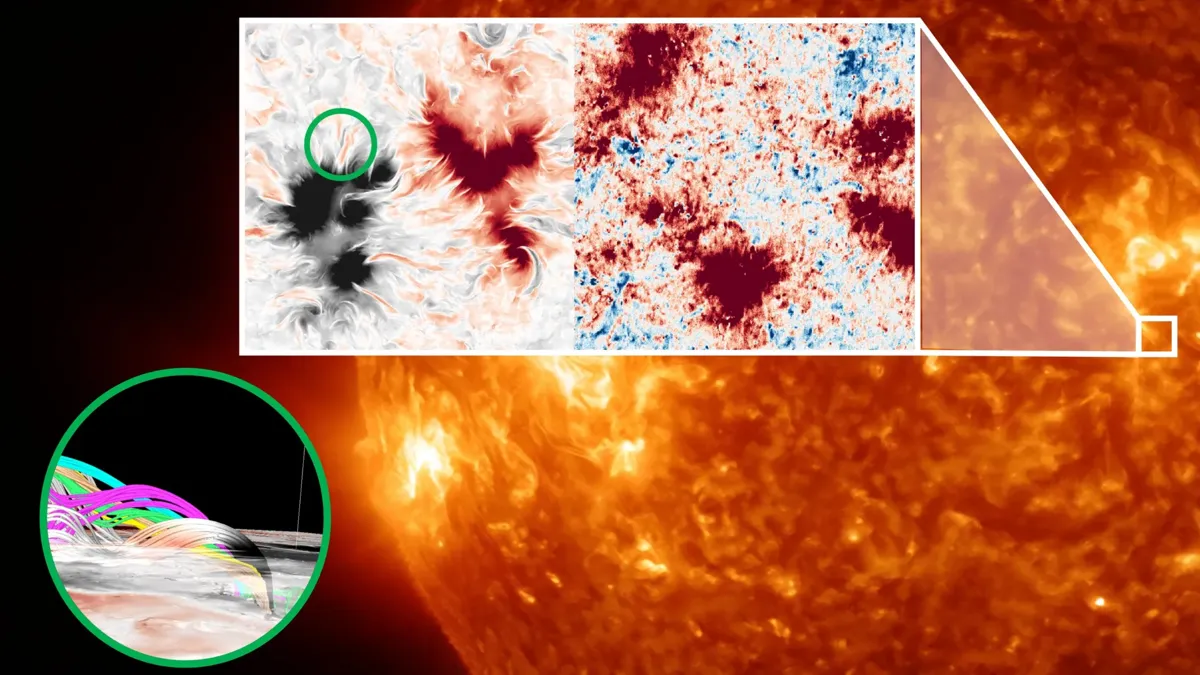
Sunrise-III detected numerous thin, elongated magnetic structures woven into a larger network of magnetic fields above a quiet region of the Sun. This network, called the magnetic canopy, extends through the chromosphere, the layer of the solar atmosphere above the visible surface (the photosphere). It forms as magnetic fields concentrated at the surface spread outward and arch upward.
Rather than a smooth, uniformly expanding structure, the observations show a canopy containing many narrow, thread-like features. Computer simulations reproduced the patterns recorded by Sunrise-III, suggesting that motions on the solar surface twist the magnetic field lines and create the intricate structures seen higher up.
Jets and changing fields
The observatory also looked at another quiet region near the solar limb, the visible edge of the Sun. There it measured magnetic fields inside spicules, narrow jets of solar material that rise from the surface, and showed how the distribution of the fields changes with height.
Why quiet regions are hard to study
Quiet regions lack prominent features such as sunspots and cover most of the Sun, but they are not magnetically inactive. Their fields are generally weaker than in active areas, and ground-based telescopes struggle to measure subtle structures because turbulence in Earth's atmosphere blurs fine details.
Sunrise-III is built around a 1-metre telescope. During its 2024 mission it floated roughly 35 kilometres above Earth, where atmospheric interference is greatly reduced. One of its instruments, SCIP (Sunrise Chromospheric Infrared spectroPolarimeter), is a near-infrared instrument developed under NAOJ's leadership that measures magnetic fields continuously across layers from the photosphere to the chromosphere, so researchers could see how structures change with altitude.
The chromosphere therefore holds far more intricate magnetic structure than a simple expanding canopy would suggest. Understanding it could help explain how energy produced by motions near the surface is carried into higher layers and contributes to heating the Sun's atmosphere, including in regions that look calm from afar.
More space discoveries are in our Science section.