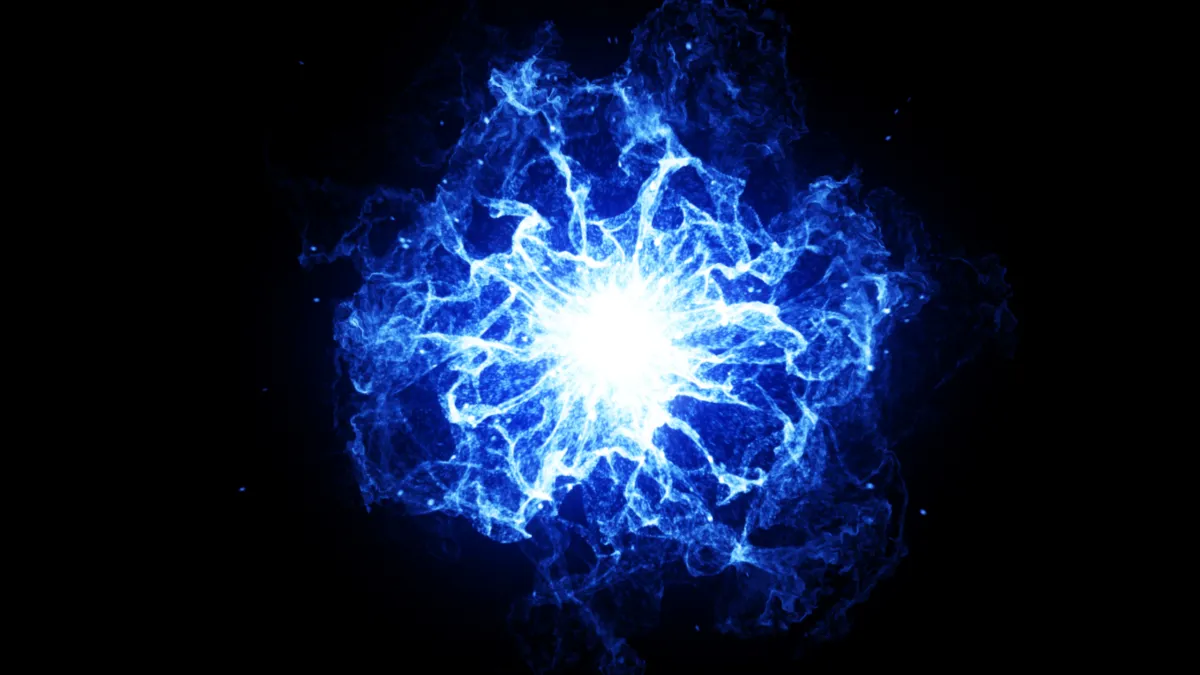
Lab-Made Plasma Ball Behaves Like a Soliton, a Clue to Ball Lightning
Physicists in China have produced a tiny glowing plasma sphere that keeps its structure as it expands, behaving like an electromagnetic soliton, a self-contained wave. The team led by Chuliang Zhou at the Chinese Academy of Sciences reports in Nature Photonics what it calls the first controlled generation of a macroscopic, long-lived soliton driven by relativistic terahertz electromagnetic fields. The result could help explain ball lightning, a phenomenon reported for centuries and almost impossible to study in the field.
Why ball lightning is so hard to study
Ordinary lightning is a jagged flash that vanishes faster than a blink. Ball lightning, by contrast, is described in thousands of records and eyewitness accounts as a ball that hovers above the ground and then disappears with a pop, like a soap bubble. Reports vary wildly in its size, color and behavior, which makes it one of the most peculiar puzzles in atmospheric science.
A soliton is a single, self-contained wave that keeps its shape through a delicate balance of competing physical forces. Solitons can form in plasma, water and light, wherever such a balance is possible. Some theories hold that ball lightning is an electromagnetic soliton that traps energy in a shell of plasma. Plasma is a gas whose atoms have lost electrons.
How the sphere was made
The researchers used a tungsten needle whose tip is only 100 nanometers across; a human hair is 80,000 to 100,000 nanometers wide. An ultrashort laser pulse fired at the needle generated a powerful electromagnetic wave that traveled along its length. At the tip, the wave's energy concentrated into an extremely intense electric field that stripped electrons from atoms in a cloud of argon gas, creating a superheated bubble of ionized argon.
The luminous sphere started at around 80 micrometers across and grew to several hundred micrometers over the next 100 nanoseconds. That is far longer than the electromagnetic pulse that created it, and the sphere held its structure while expanding instead of dissipating like an ordinary cloud of hot plasma.
What the measurements showed
The team tracked the expansion and analyzed the wavelengths of light the sphere emitted as it cooled, comparing the observations with theoretical models and computer simulations. The expansion matched the predictions for an electromagnetic soliton, which suggests that electromagnetic energy stayed trapped inside the plasma. Simulations of ordinary thermal expansion produced a much faster, more diffuse process.
Far from a full explanation
A tiny dot of light in a controlled laboratory experiment is far from the atmospheric conditions in which ball lightning is reported. The researchers therefore used their models to see how the effect might scale. Their calculations suggest that solitons driven by microwaves rather than terahertz radiation could, in theory, grow to meters across and persist for seconds, closer to some eyewitness reports. This is a theoretical estimate, not an observation.
The authors write that trapping electromagnetic energy in a stable, localized structure could also open new avenues for energy-storage technologies and for studying how light interacts with matter under extreme conditions. More physics coverage is in our science section.