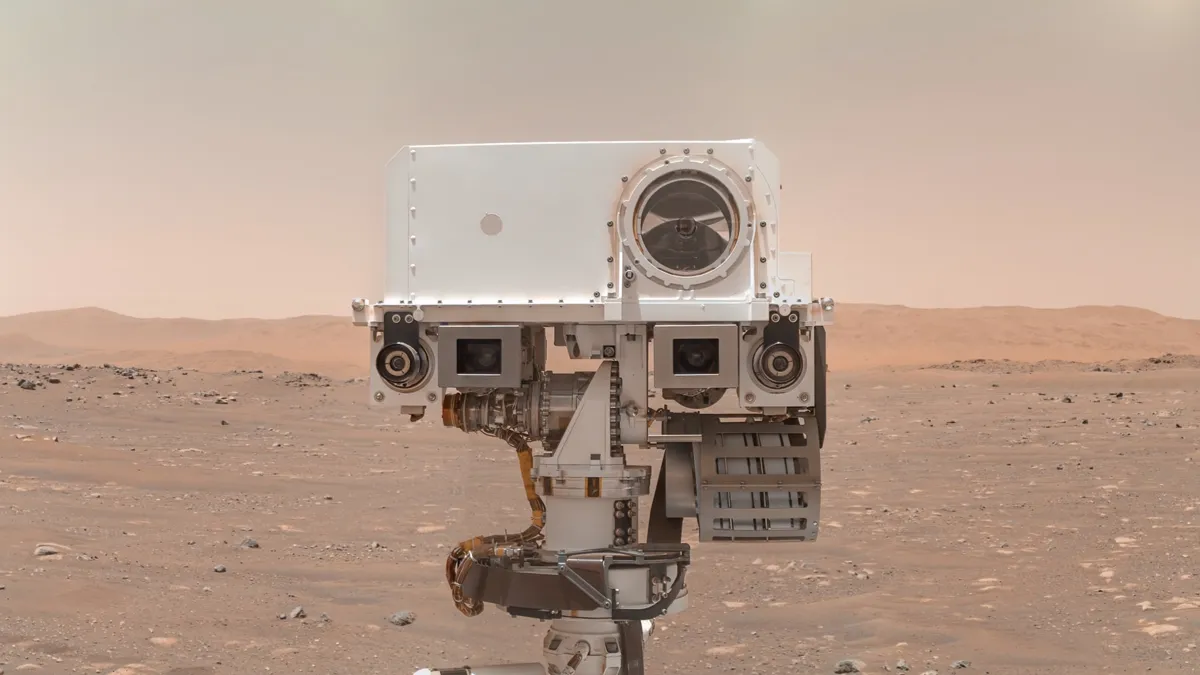
Perseverance Breaks Off-World Driving Record, Mostly Steering Itself
NASA's Perseverance rover has traveled farther across the surface of another world than any previous vehicle. On October 11, its odometer reached 45.22 kilometers (28.10 miles), passing the 45.16 kilometers that its older sibling Opportunity covered on Mars from 2004 to 2018.
A rover that mostly drives itself
Perseverance covered more than 90 percent of its record distance on its own, using its AutoNav system, which scans the terrain and picks a safe path between waypoints set by scientists on Earth. The twin rovers Spirit and Opportunity completed around 5 percent of their distance with the earliest version of AutoNav. The first Mars rover, the dog-sized Sojourner, landed in 1997 and covered about 100 meters.
The gap in perception is large: JPL scientists point out that Sojourner took 20 measurement points of the path ahead, while Perseverance processes 200,000 with each glance. It can do this at or near its top speed, "thinking while driving", and has covered as much as 412 meters (1,351 feet) in a single sol, a Martian day that is about 40 minutes longer than an Earth day.
Where it is driving now
Perseverance is on the western rim of Jezero Crater, in a region called Lac de Charmes. It is exploring some of the oldest rocks ever examined, "probably older than 4 billion years", says Ken Farley, a Caltech professor of geochemistry and former Perseverance project scientist. "There are few rocks on Earth older than 4 billion years. So we are in an area that is very deep in the history of the solar system."
On Earth, most rocks of that age have been eroded or recycled by plate tectonics. The rover has already found what may be the best evidence for extraterrestrial biology yet in a leopard-spot-speckled rock called Cheyava Falls, in a basin that held water billions of years ago. Next it is heading to Idubi, which may have been a hydrothermal system, possibly similar to those thought to have helped life arise on Earth. Another target is Rainbow Falls, a chunk of Mars torn out of the ground by the impact that created Jezero Crater.
Farley says samples matter most: "the place that will give the richest information is the one you can bring samples from." Perseverance's companion, the Ingenuity helicopter, made 72 flights over three years, covering 17 kilometers. More space news is in our science section.