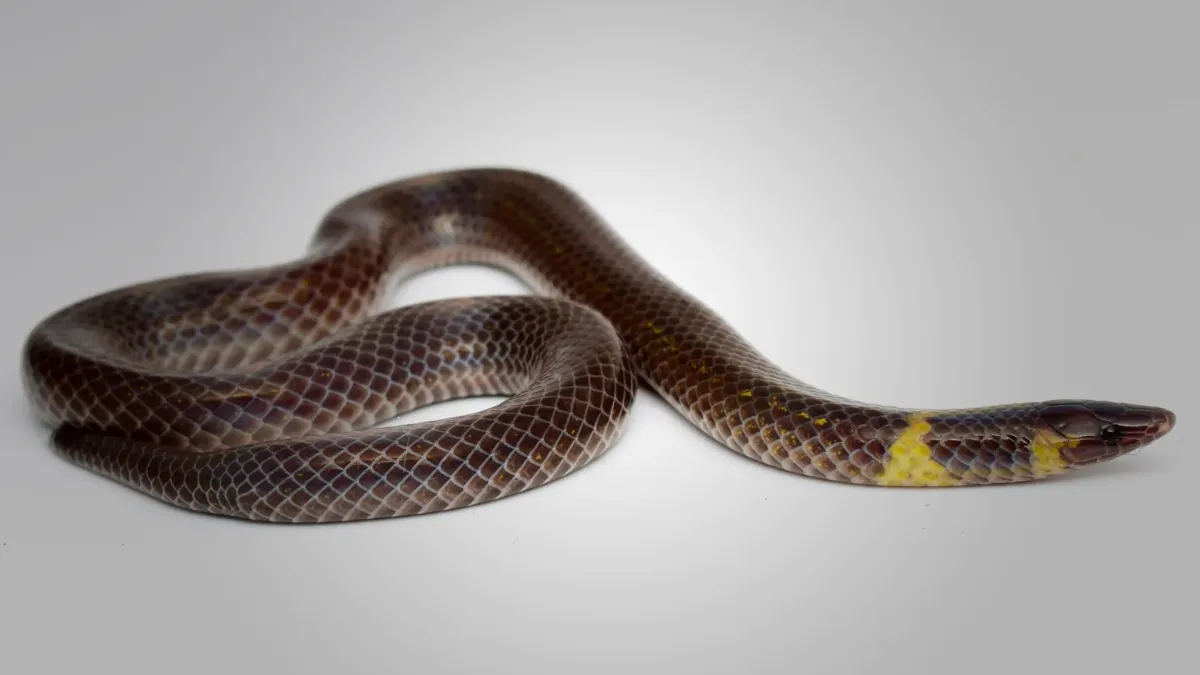
Tiny Reedsnakes Roll Four Times Faster Than They Slither
Tiny dwarf reedsnakes of Southeast Asia can roll across the ground to escape danger, reaching speeds about four times faster than their normal slither, and they do it while keeping their heads steady. Researchers describe the mechanism in Current Biology.
Why rolling is hard for an animal
A wheel spins around a fixed axle without disturbing what it carries. Animals have no such mechanism: if the whole body spins, the head and sensory organs rotate too, making it hard to keep balance and steer, and the problem grows with speed. Snakes of the genus Pseudorabdion are among the few animals known to deliberately roll to escape predators. The behaviour appears in field guides and had been documented once in the field, but the movements behind it were not understood.
What the filming showed
The researchers filmed dwarf reedsnakes from several angles and analysed how different parts of the body moved. Peak forward speeds while rolling ranged from 1.72 to 3.69 metres per second, roughly four times the snakes' maximum speed in lateral undulation, the familiar side-to-side slither. The snakes could follow a narrow racetrack only 20 centimetres across, so the rolling is not uncontrolled tumbling.
The snakes alternate between rolling on one side and swinging a curved section of the body downward beside the head. The authors call this sweep a "stroke". In each successive cycle the side touching the ground switches and the stroke changes direction, left to right or right to left; repeating this timed pattern produces continuous rolling.
A steady head
While the rear parts of the body rotate rapidly, the head stays relatively steady, faces forward and remains at a nearly constant height. At higher speeds the snakes tend to hold the head raised and minimise up-and-down motion, which may help them keep control and navigate during escapes. They do this without any mechanical separation between rotating and stabilised parts of the body.
The authors say the finding shows that body structure does not fully determine an animal's range of movements: precise coordination can make possible feats that anatomy alone would not predict. The study, led by Yosuke Kojima of Toho University, is titled "Locomotor kinematics and head stabilization in rolling snakes".
More from the natural world is in our Science section.