MIT implant uses ultrasound to spread drugs farther in the brain
MIT engineers have built an implantable device that pairs a slow-release drug reservoir with tiny ultrasound transducers so that a drug spreads farther through brain tissue. The work from the lab of Canan Dagdeviren at MIT's Media Lab was published on 26 October in the journal Device; it was tested so far in a tissue model and in mice.
The aim is to help prevent recurrence of glioblastoma, an aggressive brain tumor. Patients usually undergo surgery, but surgeons can rarely remove every cancer cell and the tumor often returns. A little more than 10,000 cases are diagnosed in the United States each year, and on average patients survive 12 to 15 months after diagnosis, according to MIT.
Why ultrasound helps
Implanted drug wafers and hydrogels already exist, but they work by passive diffusion. The MIT team wanted more control over timing and distribution. Earlier research showed that ultrasound creates convective flows that carry drug molecules farther, and that its mechanical oscillations temporarily make the blood-brain barrier more permeable.
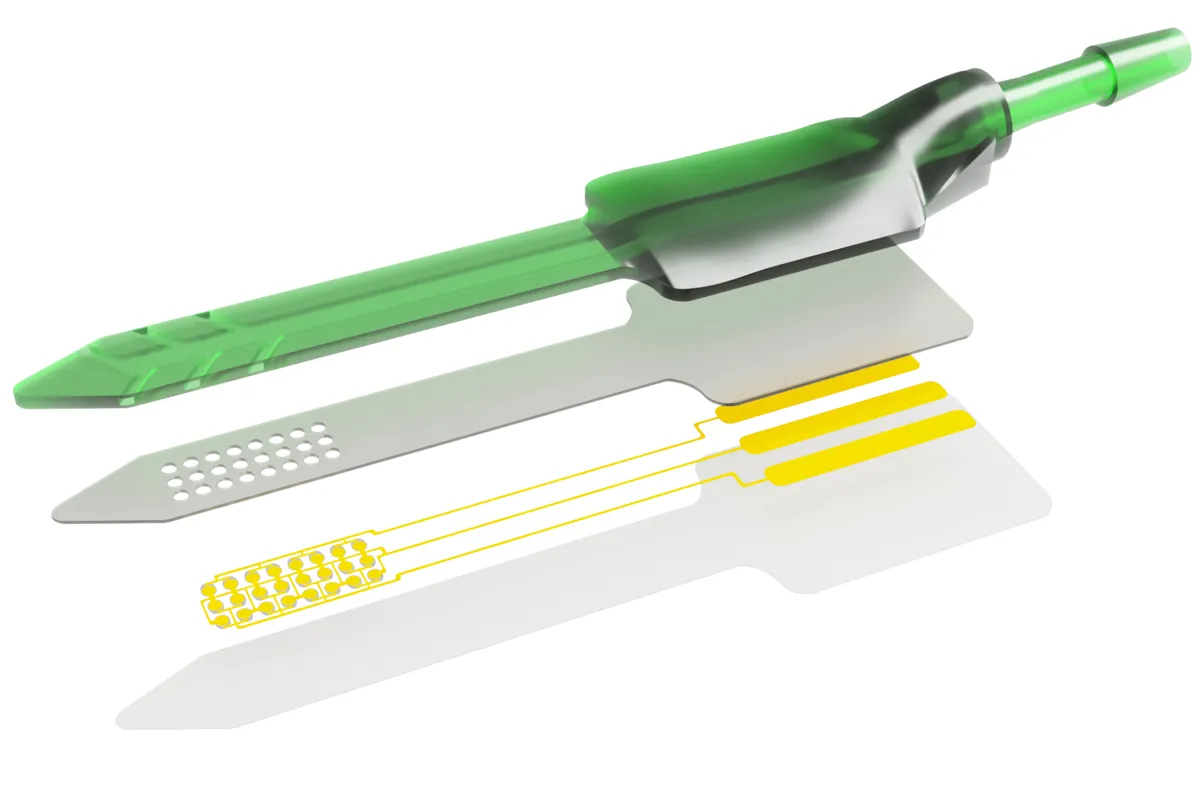
The new device, called LUCID (Long-term Ultrasound-enhanced Convective Injection Device), is a flexible implant as thin as a sheet of cardstock. A drug-delivery cannula is 3D-printed directly onto an array of 24 miniature ultrasound transducers, so the sound waves are generated at the needle tip. The reservoir holds about 100 microliters of fluid, infusion is driven by a passive osmotic pump, and the ultrasound is controlled wirelessly over Bluetooth. A small battery can be recharged wirelessly.
What the experiments showed
In a “tissue phantom”, a gel-like material that mimics human tissue, ultrasound-aided delivery spread drug molecules much farther than delivery without ultrasound. In mice, the researchers delivered an MRI contrast agent and found that it spread further through the brain when the ultrasound array was switched on. These were tests of the delivery itself; no tumor treatment was reported.
“We have 24 transducers in one ultrasound array, which can help a given drug bypass the blood-brain barrier and enhance the drug infusion,” says Dagdeviren, senior author of the study. Co-lead author Jason Hou adds: “Getting a drug into the brain is only part of the challenge. It also needs to spread through the surrounding tissue.”
What comes next
If developed for patients, the cannula and ultrasound array would sit inside the skull, while the battery and electronics could stay outside it, the researchers say. They suggest the technology could also deliver immunotherapies or nucleic acids, including gene therapies, and might be used in organs other than the brain. The study was funded by the MIT Media Lab Consortium and the National Institutes of Health. More in health and science.