Hidden Energy Loss in Silicon Carbide Defects Matters for Qubits
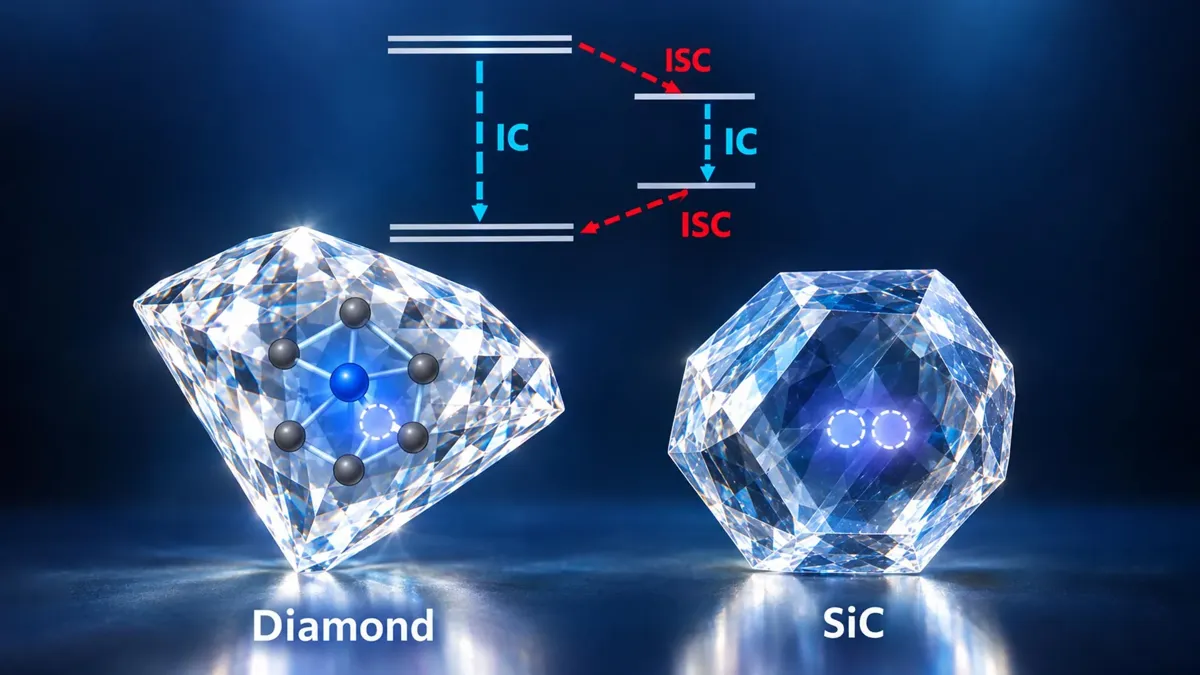
Tiny imperfections in crystals can lose energy through a pathway that earlier models underestimated, according to researchers at the University of Chicago Pritzker School of Molecular Engineering (UChicago PME). Their new computational method, reported in Physical Review Letters, simulates the entire optical cycle of a spin defect, and showed that in silicon carbide a process called internal conversion matters much more than expected.
Defects as building blocks for quantum technology
When light strikes an imperfection inside a material such as diamond or silicon carbide, it can transfer energy to electrons and push them into an excited state. These imperfections, known as spin defects, could become building blocks of future quantum technologies. They can function as stable qubits whose states can be read, which makes them attractive for quantum sensors. Predicting how their energy changes over time, however, has remained a major challenge.
After a laser excites a spin defect, it can return to its lower-energy state in several ways: it can release a photon, transition between states with different spins, or hand its energy to vibrations of the surrounding atoms. That last route is internal conversion. The equations of quantum mechanics describe the first two well, but calculating energy loss through atomic vibrations is computationally hard.
"Although the equations are known, it's hard to describe the process accurately because of computational difficulties," said Stefano Villani, a postdoctoral researcher and the study's first author. "You need to account for complex interactions between the electrons and surrounding atoms, and that's challenging in realistic solids represented by models with hundreds or thousands of atoms."
A way to calculate it
Giulia Galli, the senior author, Villani and Yu Jin combined several computational techniques their group had developed over many years. They represented the excited states of the defects with mathematical descriptions called many-body wavefunctions and derived exactly how strongly each excited state couples to the motion of nearby atoms. That let them calculate how an electronic state connects with all possible vibrations of hundreds of surrounding atoms at once, rather than one configuration at a time. Jin, a former graduate student in Galli's group, is now at the Flatiron Institute in New York.
The framework is built into WEST, an open-source simulation program optimized for graphics processing units, which Galli's group has developed over the past decade.
A surprise in silicon carbide
The team first tested the method on the nitrogen-vacancy center in diamond, a widely studied defect. The calculations closely matched recent spectroscopy measurements. For triplet states internal conversion contributed little to energy loss, while in singlet states it was the main mechanism, both as scientists had expected.
The picture changed for a divacancy defect in silicon carbide. There, internal conversion has a much greater influence on the lifetime of the excited triplet state than earlier models accounted for, which helped explain a long-standing disagreement between theory and experiment. "We were expecting to see an effect, but of a smaller magnitude," Galli said. "What we found is that this internal conversion process turns out to be more important than we thought."
What comes next
Researchers at other institutions can now apply the framework through WEST, though the simulations still demand considerable computing power. The team is exploring ways to reduce that, including machine learning, and is extending the approach to spin defects in silicon and to materials used in energy technologies, where internal conversion also governs how energy is transferred or lost. "We provided the missing piece of the puzzle needed to completely describe the optical cycle of spin defects," Galli said.
See more research news in our science section.